
How to Motivate Your Child to Study: Helping Your Little One Learn with Love

One evening, you sat in front of the math workbook, staring at numbers that hadn't been written yet, while your child hid behind the bedroom door as if studying were some old grudge between them. Deep down you wonder: why doesn't he like studying? Why does every piece of homework turn into a battle?
The truth is, this scene isn't unusual at all. It plays out in countless homes, and it leads us to a fundamental question every mother is searching for: how can you motivate your child to study without shouting, threats, or daily battles?
Most children don't hate studying; they hate feeling forced into it. They don't see anything in their lessons that relates to them, and they don't feel the material was made for them. It's in that gap between the lesson and genuine interest that the trouble begins.
In this article, we try to get closer to the child through a mother's eyes rather than through the standards of textbooks. Together we'll go through simple, smart steps that plant a love of learning in his heart and turn studying from a burden into a space for discovery.
Ways to Motivate Your Child to Study
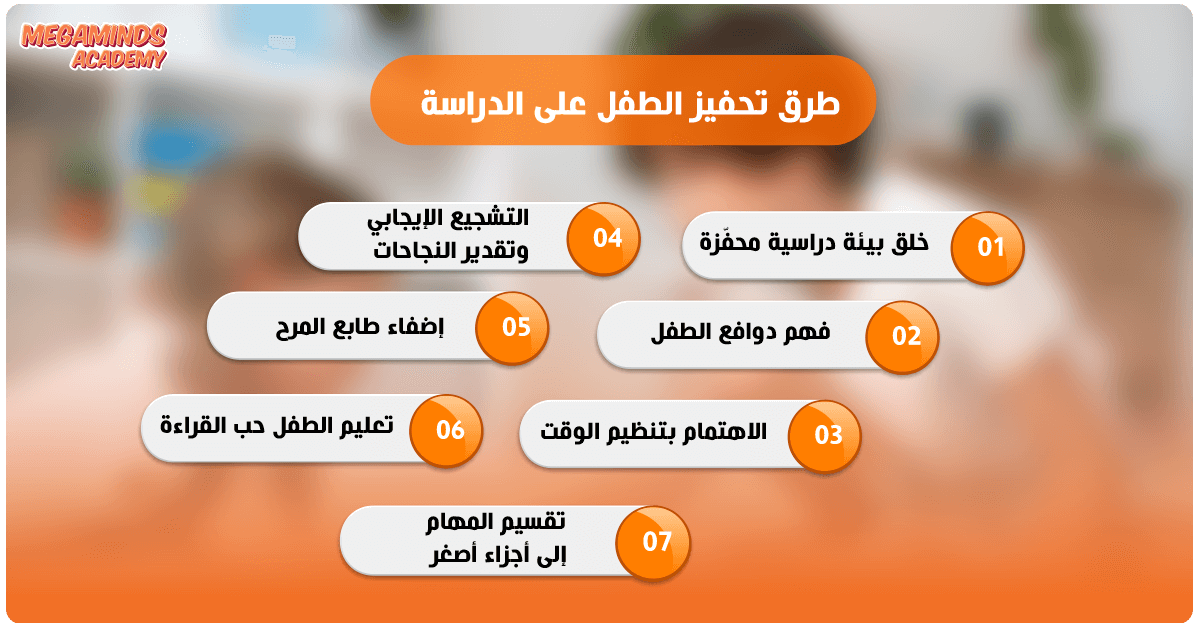
Motivating a child to study calls for a deep understanding of his needs and his nature. It doesn't rely on words alone, but on the environment and the tools we provide for him. Here are some of the most effective approaches you can use to achieve that:
Create an Encouraging Study Environment
We often blame a child for being distracted, while forgetting that his surroundings may be the very first thing distracting him!
A six-year-old can't separate the world around him from the book in his hands, so the first step in motivating him to study begins with creating a space that makes him feel safe and able to focus.
It doesn't have to be a separate room or a huge desk. Sometimes a small corner of the living room is enough, as long as it's tidy, colorful, and set up just for him. A place he knows is "his own space for learning," with his pens, his books, and maybe a poster he loves on the wall.
Add to that a few small details that make a big difference:
- Good lighting that's easy on his eyes.
- A comfortable chair suited to his size.
- An hourglass or a timer so he knows when he's done, because a child relaxes more when he can see "a clear end to the homework."
And don't forget to keep this space as free of distractions as possible: no TV running in the background, no toys spread out, and no loud noise.
Read also: Effective Ways to Handle a Child Who Refuses to Study
Understand What Drives Your Child
Does your child understand why he needs to learn? Does he see anything in studying that reflects who he is? Or is it just a string of orders thrown at him every day with no explanation?
Most children don't hate knowledge; they hate the way it's imposed on them. A child is curious by nature: he asks a lot of questions and marvels at the simplest things. But the moment he feels that studying is a burden he has no choice in, he starts to pull away.
This is where the difference shows between a child who studies because he is "forced to" and one who studies because he is "excited to."
Understanding what drives him means exploring alongside him, not investigating him. We ask: What do you like about math? Do you enjoy drawing? Would you rather we explain the lesson as a story? Do you like working with your hands?
With these simple questions, we light the first candle.
Let us also tell you that some children get motivated when they feel quick success, while others need time. Some are drawn in by colors, some by gentle competition, and others respond only when they find encouragement rather than criticism.
When we understand what drives a child, we earn tremendous trust, take his hand, and walk beside him with steady steps, no matter how long it takes.
Pay Attention to Time Management
When we talk about ways to motivate a child to study, we find that the key isn't in the number of hours he spends studying, but in how his time is divided so that he can focus for longer stretches without feeling worn out.
A child needs well-organized time: short bursts full of focus, with breaks woven in between.
There's a very simple technique called "Pomodoro," which is based on dividing time into short work intervals (about 25 minutes) followed by 5 minutes of rest.
The idea here is that the human mind can't keep concentrating for long periods, but with this small method, we give the child a chance to refresh his energy and come back with greater vitality.
Just don't forget that time management has to be flexible, because not every child can handle the same tasks, and each child has his own rhythm.
When activities alternate between work and rest, focus becomes easier and success comes closer.
Positive Encouragement and Celebrating Wins
A child doesn't need us to weigh him down with more criticism; he has no immunity against our harsh words or those glances that carry indifference toward his efforts. What he needs, quite simply, is encouragement, that simple feeling that motivates him to keep moving forward on the path of learning.
Some may think that motivating a child to study comes down to gifts and rewards, but the truth is that the best approach lies in something far simpler: encouraging the child for his small efforts, even if he hasn't yet achieved the full success we're waiting for.
We don't need to wait for a brilliant achievement to appreciate a child's work, because appreciation comes from acknowledging the effort, even when it's surrounded by mistakes. When a child feels that what he does is valued and respected, it opens a wide door to self-confidence.
Our encouragement is the fuel that keeps him going when every other incentive fades. With every kind word and every encouraging smile, his enthusiasm grows, and he feels capable of achieving more, even if his first steps are unsteady.
Add a Touch of Fun
What many people don't realize is that motivating a child to study doesn't require total seriousness; it can take shape in moments of fun.
A child has an innate curiosity, and curiosity can't be fed by a dull routine or dry lessons. But if we can turn knowledge into a game, we open up new doors of interest for him.
There's no reason math problems can't become challenges, or Arabic lessons can't turn into an exciting adventure. When we add a sense of fun to studying, we improve the learning experience and plant in the child a lasting love of knowledge.
As a result, the child becomes more willing to explore topics and take part in solving problems, and in doing so he learns far more than he imagines.
Teach Your Child to Love Reading
In a world full of audio and video, reading might seem like just a dull way to pass the time, but in reality it's a gateway to a world of secrets that can only be discovered through books.
When we talk about ways to motivate a child to study, we have to mention teaching the child to love reading, because it's the most powerful way to broaden his horizons. It's a journey inside the child's mind that sparks his curiosity and opens the doors of knowledge for him.
A child who loves reading becomes passionate about learning and discovery, and once he finds a book to be a constant companion, the learning journey becomes less of a burden. The more a child experiences the joy of reading, the more effective the ways of motivating him to study become.
Break Tasks into Smaller Parts
When a child faces a large, complicated task, he may feel scattered or under psychological pressure, and that's perfectly natural. This is where the ways of motivating a child to study come in, which call for teaching the child how to break tasks down.
Instead of asking the child to do everything at once, we can divide the task into small, manageable parts so that the child feels capable of completing each step.
A child who learns that each part of the task represents a step toward the goal feels a greater sense of accomplishment, and with every step he achieves, his enthusiasm for the next one grows.
This breaking-down helps improve the child's focus, and it also gives him a growing sense of endurance and determination.
Finally, every child carries within him a seed of love for learning, but this seed needs someone to water it with patience, attention, and encouragement. The ways to motivate a child to study may seem many and varied, but the most important thing of all is being close to the child and understanding his little world.
And always remember that studying is a doorway to a wider life, and with every moment of support and every kind word, you plant in your child a love of knowledge that lasts and grows with him.