
How to Assess Your Child's Progress in Learning to Code

Real progress isn't measured by speed, but by direction. Many people run in place without ever realizing it.
When you look at your child sitting in front of the computer—hands moving confidently, smiling one moment and frowning the next—he might say, "I finished the code" or "I made a new game," and you smile and say, "Well done." Yet a quiet question lingers inside you: Is he really making progress? Is he actually learning, or just having fun? Is he on the right track, or do we need to adjust course?
In the world of learning to code, progress doesn't show up overnight. There's no grade book, no weekly certificates, and no teacher marking in red ink—just a long road full of attempts, mistakes, puzzling questions, and small wins that sometimes pass by unnoticed.
This is where your role as a mother comes in: watching and understanding, noticing and assessing, nudging when he stalls and celebrating when he advances. In this article, we'll walk together through a genuine, precise, and practical assessment journey. So let's begin.
Understanding the Stages of How Children Learn to Code
You can't judge a flower by the shape of its seed, or a tree by its first branch. Everything grows in its own way and blossoms in its own time. So before you ask, "Has my child progressed enough?" you first need to understand what "enough" means, and what the natural stages of learning to code are for children. We can't assess a child against a level he isn't expected to have reached yet. It would be like faulting a child who is still learning the alphabet for not writing a novel!
Coding is a journey made up of interconnected stages, and each stage builds on the one before it.
Stage One: Understanding the Core Concepts
Here the child begins to grasp the ABCs of coding—words like sequence, conditions, and loops—which at first seem to him the way math equations once seemed to us in childhood: strange, but in time, familiar.
At this stage, don't look for impressive projects. Instead, watch whether your child:
- Understands what it means for the computer to carry out commands in order.
- Can connect cause and effect within the code.
- Asks questions like, "What will happen if I change this number?"
Let us tell you here that understanding the basics is the golden rule—without it, everything built on top will collapse.
Stage Two: Simple Hands-On Practice
The child now begins to write actual code, or to use visual programming tools like Scratch. He might design a simple game, make an object move when clicked, or create an interactive story.
This is where the features of his technical personality start to show:
- Does he enjoy experimenting?
- Does he feel excited when the code works?
- Does he try to fix it when it doesn't?
At this stage, a mother needs to observe behavior to know whether her child is thinking like a programmer. Does he show focus, curiosity, and a willingness to make mistakes without fear? These signs matter far more than the outcome of the project itself.
Stage Three: Analytical and Creative Thinking
Over time, the child starts to move from following instructions to creating his own ideas. He says, "What if I add a second element?" or "I want the game to start with a sound effect."
This is the real turning point.
Here you should notice:
- Does he make a plan before starting a project?
- Does he try different solutions to the same problem?
- Does he show a kind of deep understanding, rather than mere imitation?
At this stage, the child begins his journey toward becoming a "maker" in the digital world.
Read also: More Than 10 Free Coding Platforms for Kids
Signs of Progress in Learning to Code
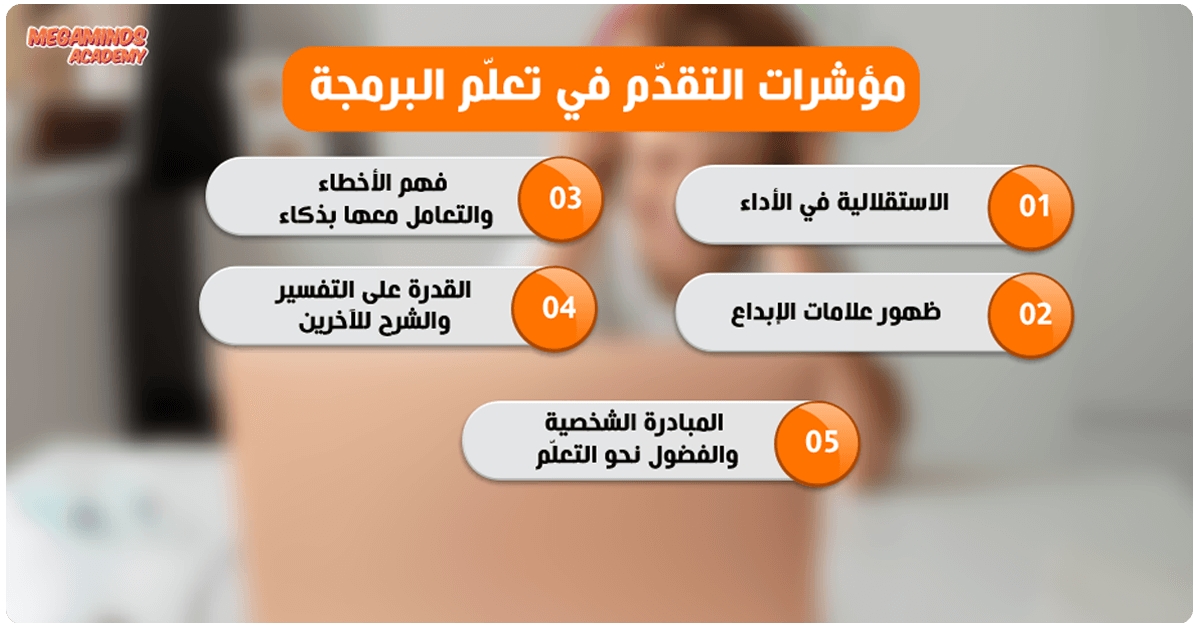
Progress doesn't always come in leaps; often it comes in tiny steps we barely notice—yet they add up and make all the difference.
Now that you know the stages, the most important question follows: How do you know your child is heading in the right direction? The truth is that coding gives you no clear grades and no instant signals, but there are subtle signs that show up in a child's behavior, his way of thinking, and how he engages with challenges. Among the most notable are:
1- Independence in Performance
At first, learning to code is like walking into a dark room for your child; everything seems unfamiliar, and relying on his mother or teacher is necessary at every step. But over time, that magical glimmer appears—the one that tells you your child has started to see the light on his own.
When a child starts opening the learning platform without being asked, his eyes lighting up with enthusiasm, that is a desire to explore, to take on challenges, and to be independent.
Independence doesn't mean he no longer needs you; it means he has begun to use you as support, not as a crutch. He doesn't come to ask about every line of code—he tries first, makes mistakes, reviews, and then asks, not to give up, but to keep going.
This subtle difference is the very heart of mental growth in coding: a child knowing how to stand on his own for a moment before reaching out for a helping hand.
Imagine your child walking into his room, opening the computer, browsing through his old projects, examining code he wrote last week, spotting a small bug, trying to fix it, and smiling when it works—without telling anyone a thing.
A child who is independent in coding doesn't need constant supervision, because he has started to feel that the project is his own, and that every line of code he writes is a fingerprint that belongs to him. And how beautiful it is for a mother to watch her child move forward with steady steps—not because she taught him everything, but because she taught him how to learn.
2- The Appearance of Signs of Creativity
When a child decides to go off-script—not content with applying what he learned word for word—know that coding is no longer a "lesson" in his eyes, but has become a tool for expression.
He no longer treats it as homework, but as a paintbrush or a pen with which he writes his ideas. He wasn't asked to change anything, yet he changed it; he wasn't asked to add anything, yet he added it—and here lie the first seeds of creativity.
Watch how he modifies the ready-made projects the learning platform provides. Does he change the look? Add movement? Introduce an idea he hasn't even learned yet? It doesn't matter how simple the change is—what matters is that the idea came from him. He is no longer just executing; he is reshaping and building something of his own, and that is creativity.
Creativity in coding is the moment a child decides to go beyond the limits of the instructions and to say, in his own programming language, "This project expresses who I am." And with every modification, new idea, or wild experiment that may not even work, the child grows as a thinker and a visionary.
3- Understanding Mistakes and Handling Them Wisely
In the early days of learning to code, your child may get angry when the code doesn't work the way he wants. He frowns and walks away from the computer. But watch closely. At some point, something different will begin.
He won't shut the device down right away; instead, he'll step back, examine, change a small number, and try again. And if that doesn't work, he'll search online or ask you. Right here, in this calm, reflective behavior, his programming maturity shows.
For a child to understand that mistakes aren't failure, but a sign that something hasn't been understood yet, is a tremendous inner transformation. It's as if coding helps him learn how to be patient, precise, and unhurried.
And don't underestimate this skill, because it will reach beyond the computer screen. The child who learns how to face a coding error without breaking down will be the very same child who doesn't fall apart when he makes a mistake on an exam, fails at an experiment, or faces rejection.
Read also: The Easiest Programming Languages for Kids to Build Their Digital Skills
4- The Ability to Explain and Teach Others
When a child begins to explain what he has done—whether to you, his younger sibling, or even his friend—that is the peak of understanding, because the one who explains is the one who has truly understood. This kind of expression means the child has moved beyond the "user" stage and entered the realm of being "aware of what he creates," conscious of why he does what he does.
It's also worth noting that explaining to others is a sign of confidence, and that coding has become something he is proud of and eager to share.
5- Personal Initiative and Curiosity to Learn
When your child starts asking questions before you ask them, know that you are witnessing a rare moment—a moment when learning has shifted from a duty into a passion. The child who takes the initiative, researches, and experiments on his own is no longer learning only from the outside; he has started to learn from within.
This is a massive turning point, because if you nurture this kind of curiosity, it will become a habit of mind that stays with him for the rest of his life.
Tools to Assess Your Child's Progress in Coding
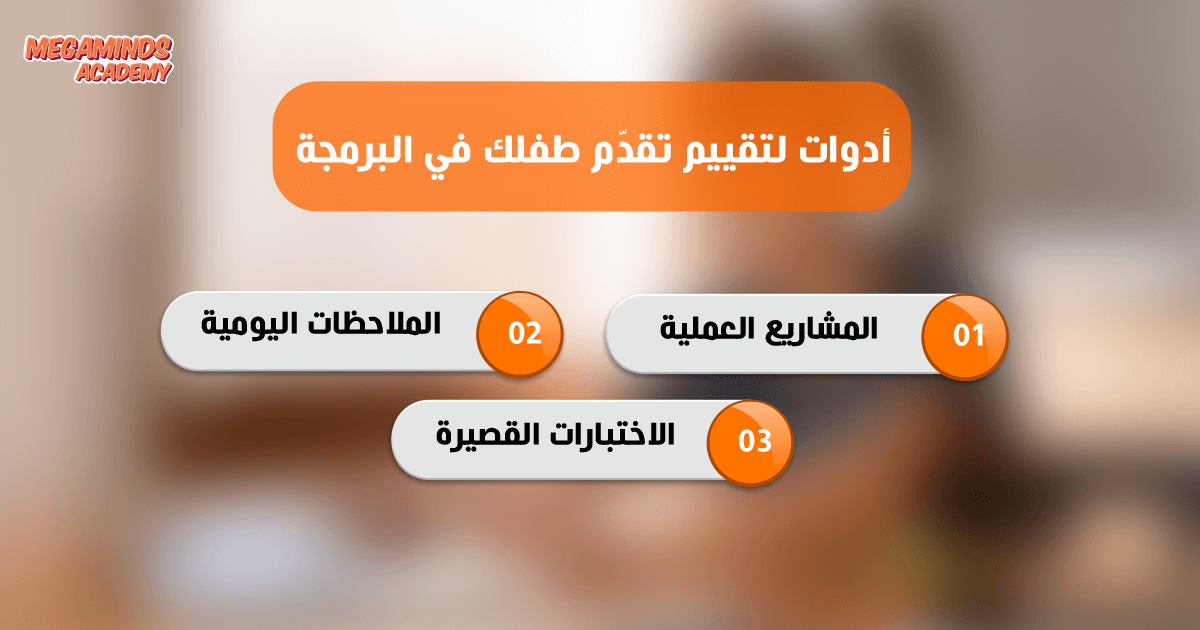
You may catch sight of talent with your own eyes, but progress requires a magnifying glass and a great deal of patience!
A smart mother needs tools and clear signs to help her measure what isn't easily measured, because learning to code, as you know, comes with no weekly certificate or report card from school. Yet progress happens slowly and quietly, slipping into small actions, ways of thinking, and the way a child looks at code.
This is where practical tools come in—tools that help you track this progress without putting pressure on your child or turning coding into a heavy test. Among them:
Hands-On Projects
Look at the projects your child carries out in terms of their ideas. Has he started to connect what he learned in lessons to something new? Does he try to create a game from his own imagination? Does he feel a sense of belonging to what he made, as if the project were a piece of him?
Projects are a natural test of knowledge, and through them deep understanding, independent thinking, and organizational skill all become visible. Every new project you observe is a new page recording his coding journey.
Daily Notes
You don't need a complicated assessment chart; just set aside a small notebook and jot down passing observations: "Today I noticed he opened his old code and modified it," "He asked me about a project idea," "He got angry when such-and-such happened."
These notes are your real treasure, for they reveal a pattern, show you a path, and help you recognize change—even if it seems slow in your eyes.
Short Quizzes
From time to time, you can ask your child simple questions in a casual way. These little quizzes help you tell whether your child understands the concepts, or is just memorizing the steps.
The difference between understanding and memorizing is huge, and knowing exactly where he stands will help you support the right path. But always remember that these questions aren't for strict assessment; they're for sharing and for sparking a thoughtful conversation between you and your child.
The Mother's Role in Supporting a Child's Progress in Learning to Code
Behind every self-confident child is a mother's hand that didn't just push him forward, but walked beside him, step by step. And coding—despite being a technical skill—needs a warm, human atmosphere. That atmosphere starts at home: from that daily session that brings you together with your child, from your smile when he succeeds, and your patience when he stumbles.
So it's important to make sure you do the following:
Constant Encouragement
Every time you tell your child "You're special," "Your idea is clever," "I'm proud of you," you build a new layer of confidence inside him.
This encouragement is a necessity, because the child who feels that someone believes in him gives more, endures more, and doesn't collapse at the first obstacle.
And encouragement shouldn't come only at the moment of success, but in the middle of the attempt, when he gets back up after a fall, and when he persists despite repeated failure.
Active Participation
It's not enough to ask him, "What did you do today?" Sit beside him and take part, even if you don't understand everything—your interest alone means a great deal to him. Say, "Teach me how you did that," or "Would you like me to help you?" This interaction turns coding from a solo task into a family activity full of support, laughter, and genuine sharing.
Providing Resources
Your child needs an encouraging environment: a quiet space, dedicated time, and a good internet connection. Above all, he needs to feel that the home recognizes the importance of what he is doing.
Let your child see that his efforts are appreciated, and that there is someone who cares about what he creates on that small screen.
Providing a supportive environment also means the psychological atmosphere: comfort, stability, and safety—and all of that, you alone are able to give.
Handling the Challenges and Difficulties of Teaching a Child to Code
Learning to code for children, even though it sometimes seems fun and smooth, is at its core a demanding journey—not because coding is hard in itself, but because it provokes the mind, forcing it into logical thinking, trial and error, and persistence despite complexity.
These are things that aren't easy even for adults, so how much harder are they for a child's mind that is still developing?
A day will come when you sense that your child is tense because he doesn't understand why the code won't work, or he may lose his enthusiasm and turn to something with a faster reward, like video games.
Here the challenge lies in the child's mood, his self-confidence, and in your ability as a mother to contain his frustration and guide it gently.
Your role at this stage is not to make him feel that a mistake is a failure, and to let him know that you see every attempt as a step forward, even if it doesn't produce an immediate result.
So when he tells you the code isn't working, don't rush to fix it for him; instead say, "Come, let's discover together where the problem is." You may not know the solution, but you offer him emotional support that restores his confidence that he isn't alone.
As for achievements, don't underestimate them, even if it's just making an element move at the press of a button. These simple moments are the ones that plant within him a love for what he's learning, and build inside him the motivation to keep going despite any difficulty.
Don't Walk Alone—We're With You at "Megaminds Academy"
Sometimes the problem isn't the road itself, but the fact that we walk it alone. You may reach a moment when you ask yourself, "Is this progress normal? Or is my child falling behind?" Perhaps you notice that he tries but can't get past a certain level, or you discover that his enthusiasm has faded—not because he's bored, but because he needs someone to understand him, guide him, and take his hand in a way that suits him.
This is where outside support comes in—not as a replacement for your role, but as an extension of it.
At "Megaminds," we fully understand what you're going through, and we know you want the best for your child, but you don't always have the technical tools, the time, or the experience to give him everything he needs.
That's why, at the academy, we have designed dedicated learning tracks that start from scratch with your child, beginning at the age of six. In every track there is simple, easy-to-understand content, specialized instructors, and hands-on projects that build a child's self-confidence and let him learn without feeling bored or pressured.
So if you ever feel that your child needs a push, or that the two of you need someone to map out the path clearly, we are here as your companion on your journey through the world of coding.
Finally, your child's journey of learning to code is about building a way of thinking, self-confidence, and a healthy relationship with technology. And you are at the heart of this journey, paving the way, providing safety, and planting motivation.
Assessing progress is an art of observation, listening, and embracing. With every step your child takes, even if it seems small, remember that you were there—nudging him gently, encouraging him with love, and believing in him even when he hesitates.
And if you ever stand in the middle of the road wondering, "Is my child heading in the right direction?", know that we are here for your child. At "Megaminds," we walk with your child, step by step, with patience and understanding, and with a hand that knows how to embrace the journey.
Get in touch with us today, and learn more about the learning tracks prepared especially for children.