
The Importance of Mothers Joining Their Children in Learning to Code
We live in an age that knows no patience. Everything around us moves quickly. Devices respond at the press of a button, programs are created in moments, and a small child in their room uses words we never grew up hearing—words about code and scripts, games they design themselves, and worlds they build with their imagination.
But what if you stepped a little closer? What if you shared this world with them? Do you think coding is just complicated code and strange symbols? Well, it is more like putting together a puzzle—but a puzzle that can power a game or build an app that might change your child’s life, and yours too.
When you join your child on the journey of learning to code, you open the door to the future together. In this article, we explore why it matters so much for mothers to take part in their children’s coding journey. Let’s begin.
Why Does Coding Matter for Children in the Digital Age?
In the past, the core skills were limited to reading, writing, and arithmetic. Today, however, a fourth skill is making its presence strongly felt: coding.
The truth is that teaching a child to code from an early age helps them:
Develop Logical Thinking and Problem-Solving
When your child learns to code, they begin to understand how things are built, how to face mistakes, and how to find solutions on their own. In turn, the child becomes able to think calmly, analyze a situation, and then build their own way out of it—a skill that will stay with them at every stage of life.
Boost Creativity and Imagination
Picture a child designing their own game, adding the elements, choosing the colors, and deciding what happens when a certain button is pressed.
Here the child shifts from being a “consumer” of content to a “creator” of it. Every idea in their head can be turned into code, and every line of code helps them make something new.
Build Self-Confidence
When a child completes a small coding project successfully—however simple—they feel a pride beyond price. Coding teaches them that a mistake is not the end of the road, but a step along the journey.
This is what sets it apart from many other skills: success comes after a series of attempts, and every failed attempt brings them one step closer to success. It is a philosophy for life.
Why Should a Mother Join Her Child in Learning to Code?
Deep in every mother’s heart lives a quiet wish: to see her child at their very best. To see them grow, learn, and stay a step—indeed several steps—ahead of their time.
But the times have changed, and so have the tools. It is no longer enough to feed our children and meet their everyday needs; we must also share their new worlds—to step through the screens with them not to watch, but to understand, to engage, and to learn.
At first glance, coding may seem like something rigid—a cold technical tool with none of the warmth of emotion or motherhood. But the truth is that it is far closer than that: it is a bridge a mother can cross to reach her child, both in thought and in dreams.
By way of example and not limitation, taking part in your child’s coding journey helps to:
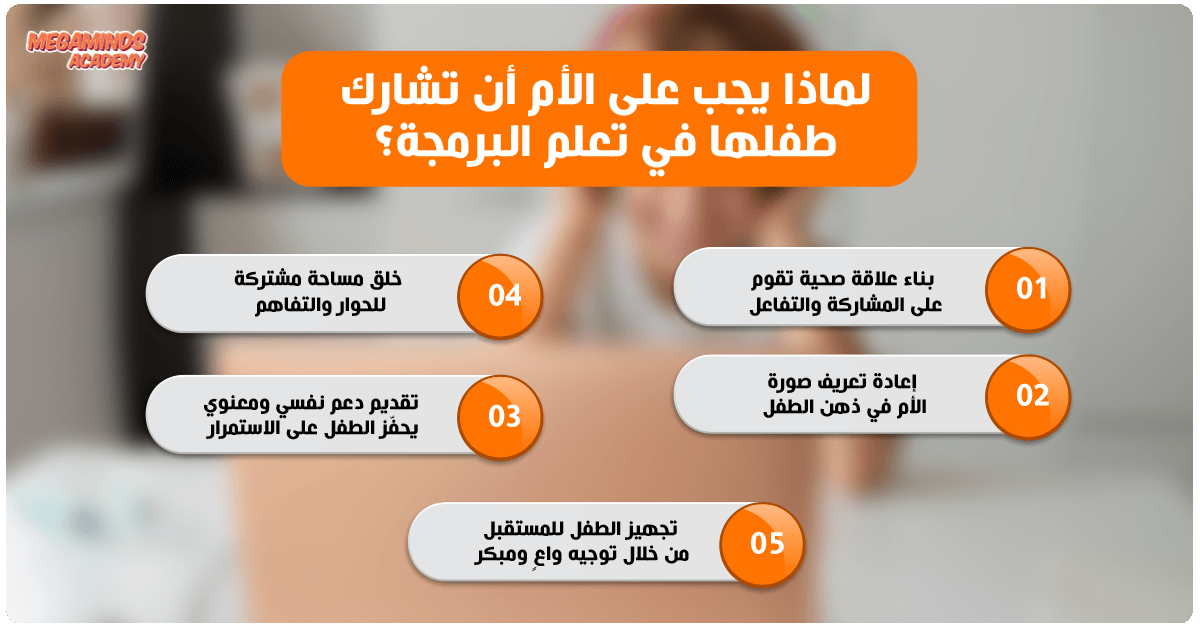
Build a Healthy Relationship Founded on Partnership and Interaction
The relationship between a mother and her child is not only one of guidance and advice; it should also be built on companionship. When a mother chooses to enter the world of coding alongside her child, she is telling them indirectly: “I am your partner, not just an observer of what you do.”
This feeling encourages the child to open their heart and share their thoughts, fears, and ambitions, because they sense that their mother is part of their intellectual world. This deepens the child’s respect for their mother, and the mother’s respect for her child grows as she watches their abilities and talents flourish before her eyes.
In turn, it becomes a new, interactive relationship that goes beyond homework and daily requests.
Redefine the Image of the Mother in the Child’s Mind
Children often see their mothers as people who do the housework, look after their studies, prepare meals, and provide care. But imagine the emotional and intellectual impact on a child who sees their mother learning a programming language to support them!
It is a new, powerful image that shows the mother as an independent person who learns and grows. In that moment, the mother transforms in the child’s mind from a traditional figure into a role model. The child develops a new awareness that learning never stops, and that women—mothers in particular—are capable of keeping pace with the times and facing challenges.
This new image inspires the child emotionally and plants within them a deep appreciation for the value of their mother—not only as someone loving, but as someone intelligent, strong, and ambitious.
Provide Emotional and Moral Support That Keeps the Child Going
A child just starting out in coding sometimes struggles to understand, and may feel frustrated when the code does not work as they wanted. This is where the mother’s true role appears: the present mother is not only the one who lends a helping hand, but the one who first offers her heart.
With a word of encouragement, a satisfied smile, or even a failed attempt she shares with her child, a mother can build the emotional energy that helps her child keep going.
Children do not need a strict teacher; they need a companion who makes them feel safe. Sometimes, it is enough for the mother to say, “I made a mistake too,” for the child to feel that failure is part of the journey, not its end.
Create a Shared Space for Dialogue and Understanding
How many mothers complain that their children do not talk to them? That the conversation between them has gone silent? The secret may lie in the absence of a shared space.
Coding, without meaning to, provides that space. It gives a mother and her child something to talk about, a problem to think through, a result to celebrate, an idea to discuss.
This kind of dialogue arises naturally from working together: the mother offers an idea, and the child develops it. The child explains a piece of code, and the mother asks how it works. From here a shared language begins—a language built on mutual respect and shared knowledge.
Through this dialogue, the mother discovers how her child thinks, what they love, when they are happy, and when they get upset—and all of these discoveries are priceless.
Prepare the Child for the Future Through Early, Mindful Guidance
Coding is no longer an optional extra; it has become one of the core languages of the modern world. Yet a child on their own does not know how to choose, and cannot always tell the difference between useful content and content that wastes their time.
This is where the mother’s role comes in—to guide and direct. A mindful mother is the one who enters this world with her child, explores it with them, and then helps them find the right path.
In this way, learning to code is no longer just a lesson, but a shared project to build a secure future. Here the mother prepares her child from a young age to understand technology through the lens of creativity and production—one of the greatest gifts we can offer a child today.
Does a Mother Need to Master Coding to Join Her Child?
A mother does not need to master coding or be a professional programmer to share this journey with her child. The aim of taking part is to be a “companion”—to show her child that she cares, that she tries, that she learns just as they do, and that she faces the challenges right beside them.
A mother’s involvement is not built on technical knowledge, but on emotional presence and psychological support. Her curiosity and her desire to learn will give the child a tremendous boost.
Children, in fact, love to explain what they know, and they feel proud when they teach grown-ups something new.
Having a mother who “learns” alongside her child creates a healthy learning environment, full of experimentation and discovery, free from the fear of mistakes or any sense of inadequacy.
So all a mother needs is a genuine desire to explore, a positive outlook on learning, and shared time with her child—and that alone is enough to make a real difference in the child’s life.
How Can a Mother Start Learning to Code With Her Child?
For a mother to decide to take part is the first half of the journey; the second half is taking that first real step.
It may feel overwhelming at first: Where do we start? Do we need books? Platforms? Will I even understand anything?
But the simple truth is that there is no need to start with a complicated plan, or to sign up for a professional course. What it takes is passion, intention, and a little shared time. From there, everything begins.
To make that journey easier, you can:
Start With Visual Platforms Suited to Children
There are learning platforms designed especially for beginners that make coding feel like play, such as Scratch, Code.org, and Tynker. On these platforms, the learner does not write a single real line of code; instead, they arrange programming “blocks” that work like puzzle pieces.
This approach allows a gradual understanding of core concepts such as loops, conditions, events, and movement, without needing to grasp the programming language itself at the start. It is ideal for building shared confidence and embarking on a fun, safe adventure.
Set Aside a Fixed Shared Time Each Week
In the busyness of life, nothing happens unless we set aside time for it. That is why it is best to choose a fixed weekly time—even just half an hour—when the mother and her child come together to learn to code.
Let this time be free of stress and strict, school-like pressure. Let them sit together, perhaps with a cup of coffee and a glass of juice, and begin a small project.
Consistency here matters more than the number of hours, because coding is built up gradually. Every successful session, however short, adds a new skill to the child and brings them a step closer to realizing an idea or a small project they can be proud of.
Turn Mistakes Into Shared Learning Opportunities
At the start of the road, mistakes will appear. Code that does not work, a movement that does not show, a sound that does not play. And here comes a pivotal moment: either the mistake turns into frustration, or into an opportunity to learn.
When a mother is present and handles the mistake with a light spirit—“Ah, it looks like we forgot to put the block in its place”—she teaches her child a great lesson: that a mistake is not a flaw, but a step toward the solution.
More important than the solution itself is the way of dealing with the challenge. Every mistake turns into a shared story between mother and child, a story told later with pride: “Remember the day our game didn’t work? And how we fixed it together?”
Practical Tips to Motivate Your Child for Shared Learning
Children are naturally curious, but they also bore quickly. A child may begin their coding journey with great enthusiasm, then suddenly lose motivation if they do not find someone to encourage and inspire them at the right moment.
Here the mother’s role comes in: presenting the experience as a fun journey, not a school assignment. Below are some practical tips that help a mother motivate her child effectively, which you can put into practice by:
Using Stories and Adventures in Coding
Using stories stirs the child’s imagination and helps them connect coding with their favorite ideas and games. The more they feel in control of the story, the more enthusiastic they become about learning and experimenting.
Celebrating Achievements
When the child succeeds in creating a small game or pulling off a new move in their coding project, do not let the moment pass as something ordinary. Celebrate it, and tell your child how you feel.
Turning Mistakes Into Fun Challenges
When the code does not work or the project gets stuck, do not say, “You made a mistake.” Instead, say, “We have a new puzzle to solve!” Just like that, the mistake turns into a game, and the problem into a fun challenge.
Make Your Child’s Coding Journey Easier With “Megaminds Academy”
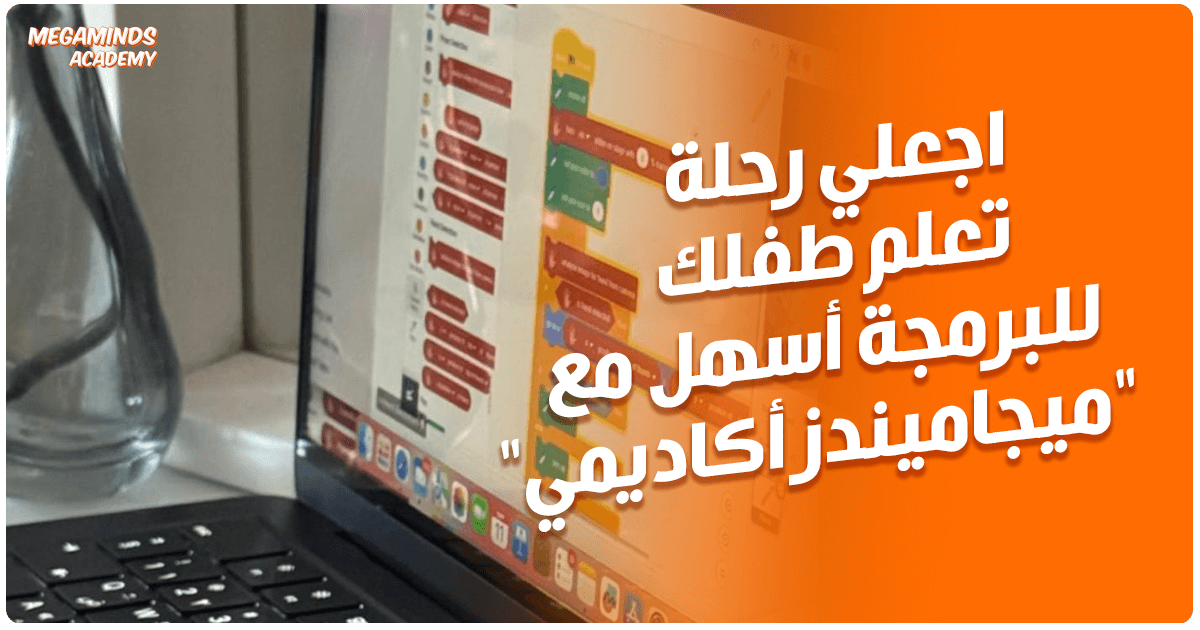
At “Megaminds,” we understand all too well that a mother’s responsibilities are many, and time always seems to be less than enough. That is why we designed our educational programs to be a true source of support for you on your child’s coding journey—not a replacement for you, but help that supports you on your journey with your child.
We are here to teach the child coding in a language they understand and in an enjoyable way. We take them by the hand through organized steps, without making them feel any pressure, and without you needing any prior knowledge.
We believe a mother’s role does not end when the child enrolls—it begins with it, through observation, questions, and encouragement. So we make it possible for you to follow along, and we give you simple tools that help you to always be present, without burdening you with the technical details.
We do not just teach coding; we build a bridge between you and your child, with a new language and a skill that stays with them for life.
Your Child’s Future Begins With Your Decision Today
Coding is a way to understand the world, and a tool that gives your child the power to express themselves, create, and solve problems. But the most beautiful part is that it can become a new doorway to bringing the two of you closer, and the starting point for an adventure you share together.
The beginning may seem difficult, or unclear. But you do not need to be a programmer to start. It is enough to be a caring, curious, present mother.
And because we know that balancing daily commitments with keeping up with technology can be exhausting, at “Megaminds Academy” we have designed dedicated tracks that help your child learn to code step by step in a fun, simplified, and safe way.
So if you want to give your little one a real start toward the future, this is your chance. Enroll your child now at “Megaminds” and begin a learning journey with them that will surprise you with its results.