
Python Basics for Kids: A Fun Gateway to the World of Coding
As a mother, you may find yourself asking: "Should I start teaching my child to code from an early age?" The answer is, without a doubt, yes. Coding today is a powerful tool that helps develop your child's logical thinking, trains them to solve problems, and teaches them patience and perseverance.
Learning Python basics is one of the best starting points you can offer your child. Python is a simple, easy-to-understand programming language, which makes it ideal for kids in their early stages.
In this article, we explore the importance of the most prominent Python basics for kids, so let's begin.
What Is Python for Kids?
Python is a programming language known for its simplicity and clarity, designed to be easy to understand and suitable for beginners, even children.
Python is a tool for training the mind to think logically and to solve problems in organized ways, as it teaches children how to lay out their ideas in clear steps and turn them into something tangible on the screen.
Through Python, a child begins to discover the world of coding in a fun and engaging way, without feeling that there are limits to what they can achieve.
Why Is Python a Great Choice for Kids?

Python is one of the most popular programming languages in the world, and it has many advantages, the most notable of which are:
Simplicity of the Language
As a mother, you may want to start teaching your child to code, but you feel some hesitation because of the complexity associated with this subject. With Python, however, there is no need to worry. This language is known for its simple, clear structure, which makes it ideal for children at an early age.
Python code is easy to read and understand, and your child can start learning the basics in a short time. It also resembles writing in natural language, which helps build your child's self-confidence and encourages them to keep going.
Strengthening Logical Thinking
By learning Python, a child begins to break problems down into small parts and then find solutions for them step by step. As a mother, you of course know that organized thinking is the foundation of success in life.
When your child learns how to think logically, this is reflected positively across all aspects of their academic and personal life.
Developing Problem-Solving Skills
When a child faces a challenge in solving a school question or a problem in their daily life, what do they do? Do they give up quickly, or do they keep trying?
Learning Python basics teaches children how to face challenges with patience and perseverance. Your child may write incorrect code at first, but these mistakes are not obstacles; they are opportunities to learn. The child learns how to fix errors and how to arrive at alternative solutions.
This kind of thinking takes root in the child's mind and helps them develop problem-solving skills, whether at school or in their daily life.
Supporting Creativity and Innovation
In Python, a child can design their own game or build a useful application. Coding is not limited to complex code; rather, it gives children the chance to create their own world through the interactive projects they build themselves.
When your child is encouraged to use their imagination in coding, a world of limitless possibilities opens up before them. Instead of being merely a consumer of technology, they become able to produce it. This boosts their confidence in their creative abilities and helps them see the world from a new angle.
Preparing Children for the Future
Wouldn't you like your child to look toward a bright future in a world full of opportunities? Learning Python basics is one of the essential skills that the future will require.
In this digital age, the earlier your child starts learning to code, the greater their chances of excelling in fields such as artificial intelligence, data analysis, and even robotics design.
How Does Your Child Start Learning Python?
You may now be wondering: "How do I help my child enter this world?"
The answer is easier than you imagine. Learning Python basics doesn't require a complex technical background; it just needs a simple plan and an encouraging environment.
Provide a Suitable Learning Environment
Your child doesn't need a lab or complicated tools. An ordinary computer or laptop, an internet connection, and a quiet space are all they need to begin with.
More important than the device is the child's feeling that you believe in their abilities and encourage them to explore. An encouraging environment means a mother who listens when they explain their code, celebrates with them when they succeed, and smiles at them when they make a mistake.
Start with Small, Fun Steps
Coding is much like a puzzle game, so start with what is fun.
Educational sites such as Scratch and Code.org allow a child to "program" without writing a single line of real code at first, and in this way they can build a game or solve a puzzle.
What happens here is that your child learns programming logic in a visual way; they understand that command (A) is followed by command (B), and that an error in the order changes the result. This understanding is the heart of coding and the cornerstone of Python basics for kids.
Use Learning Resources Suitable for Their Age
When you decide to begin the coding journey with your child, learning Python basics is the perfect launching point.
Dozens of courses exist online, but not all of them are suitable for children. Look for content designed specifically for their age — content with illustrations, a child-friendly voice, short challenges, and tasks that can be completed in a single session.
Platforms such as:
- Tynker
- Khan Academy
- Udemy (search for "Python for Kids")
YouTube also has excellent Arabic channels, such as "Learn with Kenan" or "Codengi."
There is no harm in sitting with them at the start of each video, until they get used to the voice, the style, and the way of thinking. Your presence beside them, even silently, gives them a great deal of emotional comfort.
Tie Learning to Play
A child learns when they feel in control; when they see that every piece of code they write changes something on the screen. So make coding a path to creating their own games, or to programming a story they tell.
Every small project they build is a personal victory that makes them feel capable of creating something real. The moment they finish a simple game, or see their name printed on the screen, plants in them a sense of accomplishment that memory will not easily forget.
You can suggest ideas such as:
- A "Guess the Right Number" game
- A program that greets the user by name
- A simple calculator
- An interactive story with ASCII art
Give Them Room to Try and Make Mistakes
On the journey of learning Python basics, there is a little friend who will appear often: the error, or as it is called in the world of coding, the "bug." A small error; an annoying creature, but one that can be fixed.
Every child programmer will meet this creature many times, and instead of fearing it, they should learn how to deal with it. So give your child the space to make mistakes, and don't step in to solve everything; let them search, try, and ask.
Do you know what senior developers do when their code doesn't work?
They search and experiment! Help them realize that asking is not weakness, that searching is not a flaw, and that the solution doesn't always come on the first try.
Tell them that every error they discover on their own is a treasure, and that successful code isn't made by someone who never errs, but by someone who learns from every mistake.
Educational Tools for Learning Python for Kids
Learning to code is a powerful tool for developing critical and creative thinking in children. Among the most notable tools that help them learn Python easily and professionally are:
Codemoji
It is a program that lets children learn to code by using emojis as tools for building code. This unique approach makes programming more understandable and exciting for young children.
The program presents basic programming concepts such as loops, variables, and conditions using symbols that children can easily recognize, which makes the learning process more interactive and fun.
PyGame
PyGame is a wonderful development environment for children who want to learn to code by creating games using Python. PyGame stands out for being easy to use for children and coding beginners, as it allows them to develop simple games that start from the basics and gradually grow more complex.
The program shows children how to use Python to write code that creates interactive graphics and responds to the player's commands, and it helps develop children's logical and creative thinking skills by designing their own games.
LightBot
An app aimed at children that helps them learn the basic concepts of coding such as repetition, sequencing, and conditions by solving programming puzzles. It gives children the chance to solve coding challenges interactively using a visual environment full of colors and attractive graphics.
LightBot strengthens children's ability to think logically and solve programming problems. It also enhances their planning and puzzle-solving skills, and it requires children to use programming commands to guide a small robot through various puzzles, which helps them learn how to deal with coding without needing to write complex code.
Pythonista
It is an app for iOS that lets children write and run Python code directly from their phones or tablets. The app features a simple user interface and makes it easy for beginner children to learn Python by running and testing code instantly on their mobile device.
The program provides a direct, easy coding learning experience on iOS devices, which makes it ideal for children who like to learn on their smartphones or tablets.
The app allows writing Python code through an interactive environment, where children can see the results of the code immediately and make progress step by step.
Raspberry Pi
It is an open educational platform that lets children learn to code by building projects using hardware, and it teaches children how to program embedded systems and control devices using Python.
Learning Python on Raspberry Pi strengthens children's critical and creative thinking skills and encourages them to build real projects, as children use the Raspberry Pi device to write code that controls electronic devices, such as creating a device that simulates smart lighting or building a robot that moves according to programmed commands.
CodeCombat
CodeCombat gives children the chance to understand Python basics for kids in a practical and engaging way, without feeling bored. The idea here is that coding turns into a game; the code becomes tools in their hands that they interact with as if they were magical instruments, allowing them to discover a new world while solving puzzles.
This process is a journey that begins with solving small problems and ends with developing complex programming skills, but all of this happens in a fun way that draws children in, as they have to write Python code to complete the tasks and advance through the game levels. In this way, the doors of Python basics for kids open up for them through their interaction with the game, and they feel that they hold the keys to coding themselves.
Tynker
This platform offers an opportunity to learn Python for children through a set of interactive activities that combine fun and creativity. The platform also builds on the idea of interactive games, allowing them to design their own games and program interactive stories.
Tynker provides children with a flexible learning environment where they can build their projects step by step. What makes this app special is that it encourages the child to explore new horizons by building interactive games and graphics that they can engage with directly.
This platform turns coding into a living experience, as the child chooses how to shape their project and makes the changes they want — all using Python, which enables them to gain Python basics for kids in a fun way.
EdX
It is a site that offers outstanding educational courses in collaboration with major universities such as MIT and Harvard, and it includes Python learning courses designed for children and teens who want to learn coding in an academic style. The courses cover basic programming concepts in addition to practical coding challenges.
The site provides an academic experience for children and teens who are looking to learn Python in a detailed and comprehensive way, by offering interactive courses from prestigious universities, which helps in learning the basics of the Python language for kids.
How to Set Up a Python Development Environment
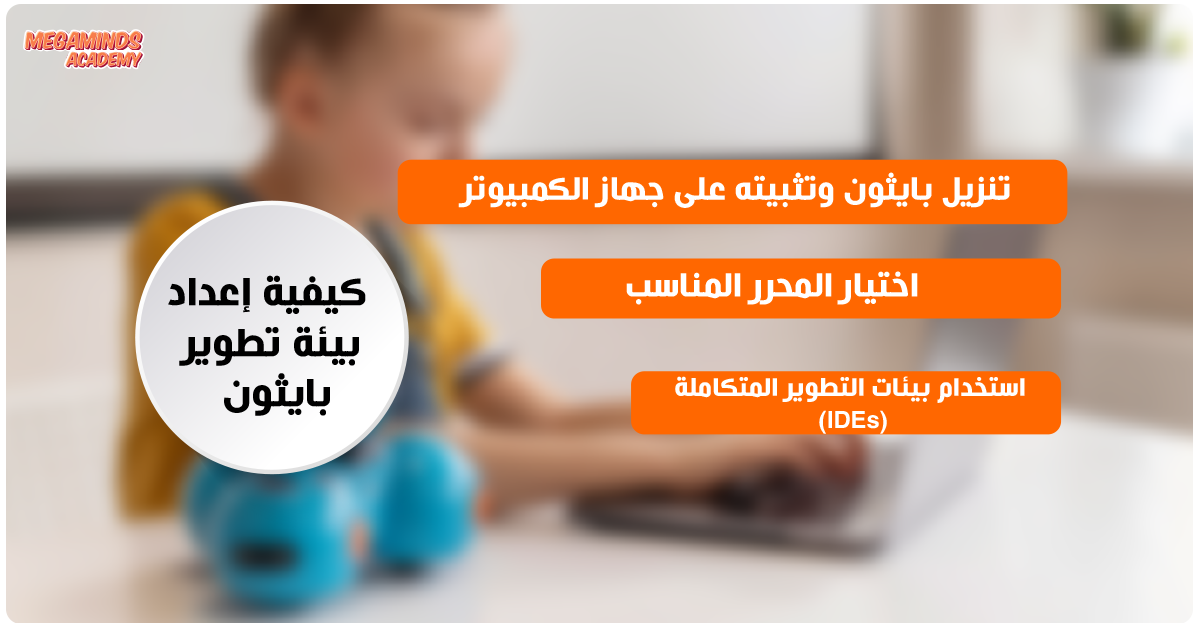
In the world of coding, the first step is the foundation on which everything is built, and when we teach our children Python basics for kids, setting up the right development environment is one of the most important steps that ensures they have a smooth and effective learning experience.
This can be accomplished through the following:
Downloading and Installing Python on the Computer
The first step that will put you on the right track is downloading Python. This language doesn't require many complications, and it can be downloaded easily by visiting the official site of the language.
All you have to do is choose the version suitable for your device, whether it's "Windows," "Mac," or "Linux," and then begin installing it. In this way, you will have laid the cornerstone for your child's first programming adventures.
Choosing the Right Editor
It isn't enough to have only Python; you also need to choose a text editor that works well with this language, since a good editor helps make writing and running code easier.
If you prefer simplicity, you can use traditional editors. But if you are looking for an integrated environment to reduce distraction, there are more advanced editors that come with tools to make it easier for you and your child to use code, such as making the code clear and understandable from the very first moment.
Using Integrated Development Environments (IDEs)
Integrated development environments provide a complete workspace for writing and running code. For example, "PyCharm" and "Thonny" offer features such as code autocompletion, error correction, and running code with a single click, which helps speed up the learning process and motivates the child to keep exploring coding.
Through these steps, a mother can prepare an ideal learning environment for her child, one that helps them understand Python basics for kids and apply them in practical projects.
Basic Python Concepts a Child Should Learn
There are several basic concepts that are the cornerstone of understanding the Python language, and when a child begins learning Python basics for kids, it is important that they get to know these concepts to ensure a strong knowledge foundation is built.
The most prominent of them are:
Variables and Data Types
Variables are "boxes" for storing information. In Python, you can store different types of data such as:
- Integers: such as 5 or -3.
- Decimal numbers: such as 3.14 or -0.001.
- Text: such as "Hello, World" or "Python is fun."
- Boolean values: such as True or False.
- Lists: such as [1, 2, 3] or ["apple", "banana", "orange"].
Arithmetic Operations
Python allows you to perform arithmetic operations easily:
- Addition: such as 5 + 3
- Subtraction: such as 5 - 3
- Multiplication: such as 5 * 3
- Division: such as 5 / 3
- Integer division: such as 5 // 3
- Remainder: such as 5 % 3
- Exponent: such as 5 ** 3
Conditional Statements
Conditional statements are used to make decisions based on certain conditions:
if age >= 18:
print("You are an adult")
else:
print("You are a minor")
In this example, if the age is 18 or more, "You are an adult" will be printed; otherwise, "You are a minor" will be printed.
Loops
Loops are used to repeat the execution of a portion of code several times:
- The for loop to iterate over a set of elements
- The while loop to repeat as long as the condition is true
Functions
Functions are sets of code that can be called to perform a specific task:
def hello_world():
print("Hello, World")
hello_world()
In this example, we created a function that displays the message "Hello, World" when it is called.
Libraries
Libraries are sets of ready-made code that can be used to extend Python's functionality:
import random
random_number = random.randint(1, 10)
print(random_number)
In this example, we used the random library to generate a random number between 1 and 10.
"Megaminds Academy": A Launch Toward Python Basics for Kids with Confidence and Creativity
At "Megaminds," we believe that coding is a tool for opening new horizons for children's minds. That is why we offer them diverse learning tracks that begin with the basics and reach advanced concepts in artificial intelligence.
The "Python and Artificial Intelligence" course is a pivotal step in the software programming track, as it offers children aged 6 to 18 the chance to learn text-based coding using the PictoBlox program, which is one of the most prominent global tools for teaching coding to children.
The course runs for 3 months, during which the child will acquire basic concepts such as variables, functions, and loops. Through practical activities, such as designing the "Beetle in the Maze" and "Brick Breaker" games, the child transforms from a consumer of content into a producer of it, which enhances their programming skills and develops their abilities in logical thinking and problem-solving.
Conclusion
In a world where technological progress is accelerating, coding is becoming the language of the era. But what if that language were "Python"? A smooth, flexible language, ideal for children taking their first steps into the world of coding.
By learning Python basics, the matter isn't limited to understanding a programming language; it extends to developing problem-solving skills, logical thinking, and innovation. It is a journey that begins with simple letters and ends with worlds of creativity.
And at "Megaminds Academy," we offer you a golden opportunity to guide your child toward this bright world. Contact us today, and let us help them build their digital future with confidence and creativity.