
More Than 15 Ways to Develop Your Child's Thinking Skills
It all starts with an innocent question from your child: "Mom, why is the sky blue?" So you look for a quick answer to put the curiosity to rest: "Because that's just how it is, sweetie." And right there, without realizing it, you may have closed a door that could have led your child toward thinking and analysis.
Developing children's thinking skills isn't about feeding them answers; it's about giving them the tools to ask the right questions, draw conclusions, make mistakes, and try again.
In this article, we explore together how a mother can become the guide who leads her child into a world of thinking and creativity, without killing that curiosity with a single word!
What does developing children's thinking skills mean, and why does it matter?
You might assume your child's thinking will develop on its own over time, but in reality it's more like a muscle that needs constant exercise.
Developing children's thinking skills means helping them analyze, draw conclusions, and connect ideas to one another, rather than simply memorizing information as it is.
At this stage of life, a child begins to question everything, and this is where your role comes in: guiding them in a way that sparks their imagination and broadens their understanding.
When a child learns to think the right way, they become better at solving problems and more ready to face the challenges of the future with confidence and intelligence.
Mental development in 6-year-old children
At the age of six, a child's mind becomes like a sponge, absorbing everything around it at an astonishing pace. They start asking deeper questions in an effort to make sense of the world according to their own logic, and they may sometimes surprise you with answers that seem perfectly reasonable despite their innocence.
This stage is the fertile soil in which children's thinking skills grow, as the child begins to distinguish between causes and effects, connect events to one another, and even share their opinions on things in a way you've never seen before.
Here your role is decisive: you can either nurture this curiosity and encourage thinking, or kill it with brief answers that end the conversation before it even begins!
Types of thinking in children
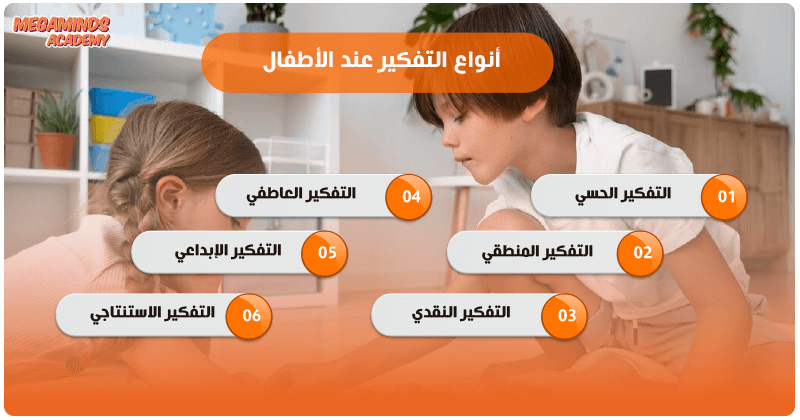
Some people assume that children all think in one single way, but the truth is that thinking in children is varied and evolves as they grow. Its types include:
1- Sensory (concrete) thinking
The child relies on their senses to explore the world around them, learning through touch, taste, hearing, and sight. This type of thinking is the foundation on which the child builds their understanding of the things around them.
2- Logical thinking
The child begins to understand the relationships between causes and effects, such as realizing that pushing a ball makes it move, or that mixing two colors produces a new one. This helps them deal with everyday problems using rational solutions.
3- Critical thinking
This is the child's ability to analyze information and question it rather than accepting it as is. When they ask "Why?" or "How does that happen?", they are on their way to developing the critical thinking that enables them to tell facts apart from opinions.
4- Creative thinking
This shows in the child's ability to imagine new ideas or come up with unconventional solutions. It appears in imaginative play, drawing, storytelling, and even in the way they handle everyday problems.
5- Emotional thinking
This is tied to the child's understanding of their own feelings and the feelings of others, which helps them build strong social relationships. When they empathize with story characters or feel happy about helping a friend, that is a sign of their emotional thinking developing.
6- Deductive thinking
This relies on the child's ability to connect events and reach conclusions based on the available information. For example, if they notice that the sky is full of clouds, they might predict that it will rain soon.
All of these types overlap and develop as the child grows, helping them build an independent personality that is able to face challenges with intelligence and confidence.
Ways to develop children's thinking skills
It's important that we guide children well from an early age toward critical and creative thinking, so that we help shape their personalities and their ability to solve problems and make decisions.
Here are some effective ways to develop these skills:
1- Asking open-ended questions
Instead of giving ready-made answers, use questions that open the door to thinking and exploration. For example: "What do you think will happen if we do this?" or "How could we solve this problem in a different way?" These questions encourage thinking and engagement, which makes them an important step in developing children's thinking skills, as the child learns how to express their ideas logically and independently.
For instance, if you ask your child to tidy up their toys, ask: "How can we arrange these toys in a way that makes them easier to reach?"
2- Encouraging mind games
Games such as puzzles, Sudoku, or memory games are wonderful tools for developing children's thinking skills, stimulating analytical and logical thinking, and building problem-solving skills through structured thought.
When it comes to solving a puzzle, for example, we find that it requires the child to focus on the details and use logical reasoning to arrive at the solution.
3- Teaching problem-solving
Let your child face simple problems and help find solutions. For example, if their toys are scattered, they can think about how to arrange them in a creative way.
Or when they run into a problem with a school assignment, they can think about different ways to solve it, which supports logical thinking and boosts their confidence in their own mental abilities.
4- Developing creativity through art activities
Art activities such as drawing, coloring, and making crafts contribute greatly to developing children's thinking skills, especially creative thinking.
Through them, the child is able to express themselves with new ideas and begins to develop their imagination, along with unconventional and inventive thinking abilities, which helps develop the child's thinking overall.
5- Encouraging independent thinking
By giving children the chance to make small decisions in their daily lives, such as choosing their clothes or deciding which activities they want to do, you encourage the development of children's thinking skills.
When a child makes their own decisions, they start to think independently and weigh the options in front of them, which helps build their personality and strengthen their confidence in their intellectual abilities.
6- Using educational stories
Stories that carry a moral lesson or address a particular problem are an effective way to teach children critical thinking skills.
After reading the story, ask your child about the better solutions or the ways the characters should have behaved. This helps them think about consequences and make decisions.
7- Giving the child space to explore
By allowing your child to explore their surroundings, whether outdoors or inside the home, you can significantly boost the development of children's thinking skills.
When a child interacts with things and discovers new ways to engage with them, they learn how to notice the small details and how to connect different concepts, which opens new doors of ideas for them and contributes to developing critical and creative thinking skills.
8- Social interaction with other children
A child's interaction with their friends in a social setting is a wonderful catalyst for developing collaborative thinking skills. When a child engages with others in cooperative games or shared activities, they learn how to negotiate, cooperate, and share ideas, which helps broaden the scope of their thinking through shared experiences with others.
9- Practicing daily mental exercises
Setting aside time each day for mental exercises such as memory games or puzzles stimulates the child's mental thinking.
For example, a child can play games that require remembering information or solving puzzles that involve logic, which strengthens their memory, boosts their ability to concentrate, and develops critical and analytical thinking skills.
10- Encouraging imaginative play
When it comes to activities that rely on imagination, such as playing with pretend toys or role-playing different characters, we find that they encourage the child to think outside the box, which contributes to developing children's thinking skills.
By playing different characters or imaginary scenarios, the child learns to think creatively and solve problems in unconventional ways.
11- Using interactive technology tools and coding
In today's world, technology has become an inseparable part of our daily lives, almost like the air we breathe.
But let's pause for a moment and ask: how can this technology contribute to developing children's thinking skills?
The answer may lie in the educational games and smart apps that allow children to gain new skills in an unconventional way. But there's another, even more important element. That is coding. Yes, coding isn't just for grown-ups!
When children learn to code, they learn how to think, connect ideas, and solve problems. It's like solving a complex puzzle step by step, where each line follows the next until the full picture is revealed.
In this way, coding becomes a guide for children in a world full of challenges, where every part of it stimulates their thinking, lets them take control of the tools of the digital world, and helps develop children's thinking skills in ways no one expected.
Read also: How robotics programming for children helps develop creativity and thinking
12- Teaching the child how to organize their thoughts
Teaching a child how to organize their thoughts in a logical and orderly way helps develop thinking and analysis skills.
For example, you can teach the child how to write a list of the things they need to do, or use charts to explain certain concepts.
13- Listening and learning from others
Listening to others and learning from their experiences can be an important source for stimulating a child's critical thinking.
By discussing the ideas and opinions of the people around them, the child begins to think in a more varied and understanding way. A child can learn how to think in different ways through interacting with family and friends, which strengthens the development of children's thinking skills.
14- Teaching the child connected thinking
Teach your child how to link different ideas and concepts to one another. For example, there can be a connection between what they learn in math and science, or between historical events and social situations. This type of thinking contributes to developing critical and holistic thinking.
15- Practicing meditation and quiet reflection
Meditation or quiet reflection activities help children develop their ability to focus and think deeply, so practicing some breathing or calming techniques for a few minutes each day gives the child the chance to think about things deeply and calmly.
16- Involving the child in daily activities
Involving the child in daily activities is an opportunity to teach them how to think and make their own decisions. When you involve your child in tasks such as organizing items or preparing food, you give them the chance to think about the steps to get it done and encourage them to find solutions to the small problems they might run into.
In these moments, the child learns how to break a task into parts and set priorities, which indirectly contributes to developing children's thinking skills.
Strengthen your child's thinking through coding with "Megaminds Academy"
Coding is an effective way to strengthen children's thinking skills. Through it, the child begins to learn how to think logically, solve the problems that come up in front of them, and look at things from two angles: the angle of analysis and the angle of possible solutions.
But it doesn't stop there, because coding also stimulates critical thinking, which becomes more valuable over time.
The code the child writes becomes their steps toward understanding and the ability to turn random ideas into tangible results.
This is where "Megaminds Academy" comes in, as we offer courses designed for children from age 6, where a child can learn coding in a fun way built on solid foundations.
At "Megaminds Academy," the goal isn't just for the child to master a programming language, but to learn how to analyze, form ideas, and solve every problem in a creative way. Here, coding is a journey of self-discovery and developing thinking.
Finally, developing children's thinking skills is a real investment in their future. Through daily activities, using technology tools, and teaching them to code, we give them the tools they need to become critical thinkers, innovators, and capable of facing the challenges of the future.
If you'd like to strengthen your child's thinking skills effectively, "Megaminds Academy" offers you the ideal solution.
Contact us now and let us be partners in your child's future thinking journey!