
AI Tools and Apps for Kids
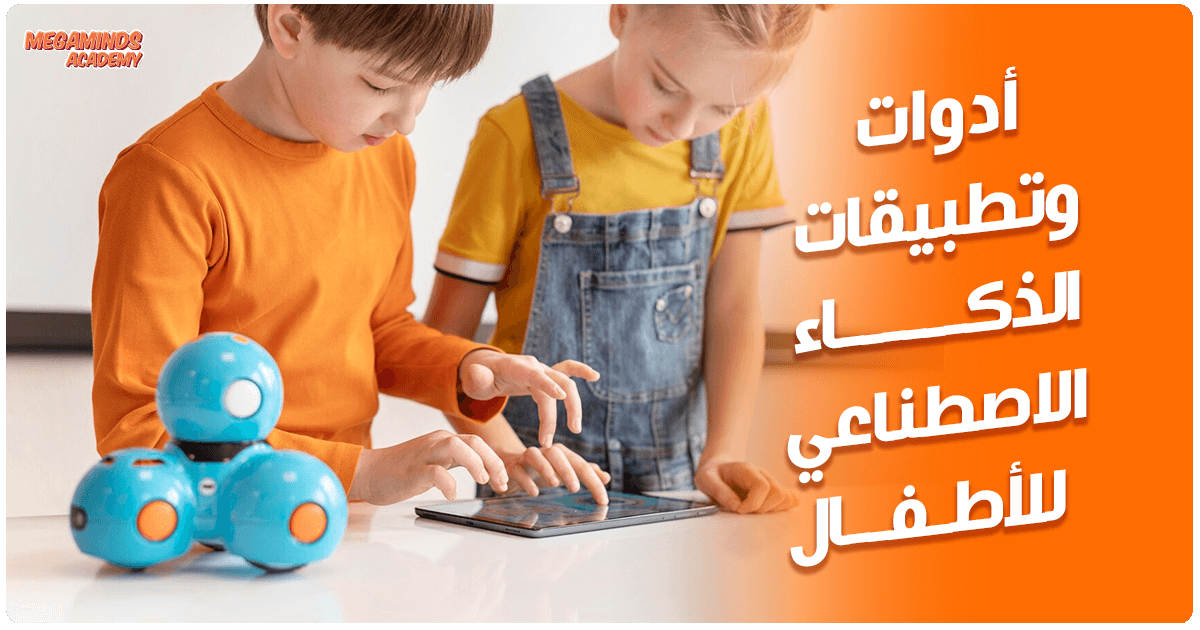
Your child won't be dazzled by the smartphone the way we once were; this generation treats technology as something completely natural. But what if we told you that your child can use artificial intelligence, understand it, and interact with it intelligently?
AI apps for kids open windows onto the future, letting them learn, create, and explore digital worlds in a way that is both fun and safe.
In this article, we review the best of these apps, how to choose the right one for your child, and how to ensure an experience that enriches their mind and grows their abilities.
What is artificial intelligence for kids?
The term "artificial intelligence" may sound complicated, but it simply refers to the ability of devices and software to "think" and make decisions in a way that resembles humans.
Before talking about AI apps for kids, imagine a robot that can learn from its mistakes, or an app that knows the words your child wants to type before they finish them; that is artificial intelligence.
What's remarkable is that children use it every day without even realizing it. When they ask a voice assistant to play their favorite song, or when an app suggests videos similar to the ones they love to watch, they are interacting with artificial intelligence without knowing its name.
The benefits of teaching AI to kids
Teaching children about artificial intelligence doesn't mean turning them into little programmers; it's about developing a range of skills in a fun, interactive way. AI tools and apps for kids help to:
Strengthen critical and creative thinking
Artificial intelligence isn't just about running games; it also helps children think in new ways.
When a child learns how to "train" artificial intelligence to solve a problem, they don't just use technology; they start asking questions: Why does it work this way? Can it be improved?
This kind of critical thinking is exactly what sets innovative minds apart.
Develop problem-solving skills and logical thinking
Imagine your child facing a challenge in an AI-based educational game. Instead of handing them the answer directly, the program tries to guide them with small steps so they can find the answer on their own.
This approach helps your child think methodically and teaches them that every problem has a solution if it's analyzed the right way.
Prepare children for future careers and technological challenges
The world is changing fast: traditional professions are evolving or disappearing, while new technology-driven jobs are emerging.
That's why teaching children the basics of artificial intelligence from an early age gives them a competitive edge and makes them better prepared for a world filled with programming, robots, and smart systems.
Who knows? Maybe your son or daughter will one day be one of the innovators in this field.
Read also about: Raising children in the age of technology
Tools for teaching AI to kids
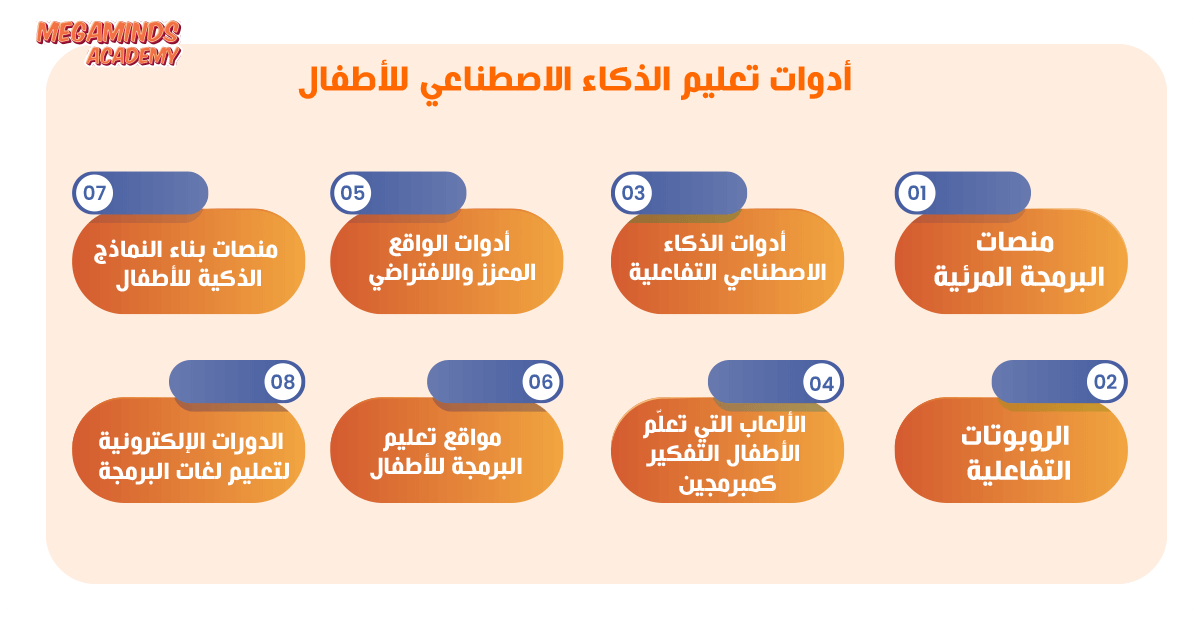
For a child to understand artificial intelligence, they need real interactions with tools that help them think like a programmer and encourage them to analyze information and make decisions, just as AI systems themselves do.
Among the most prominent of these tools:
Visual programming platforms
Learning to code is the essential first step toward understanding artificial intelligence, and visual platforms like Scratch and Blockly offer a wonderful entry point for children, letting them build programs using colorful code blocks instead of writing complex code.
At first, it feels like nothing more than a fun game, but over time the child realizes how commands can be given to a computer to perform certain tasks, exactly the way artificial intelligence works.
These tools develop children's logical thinking and problem-solving skills. For example, when a child creates a game where a character moves when a button is pressed, they begin thinking about how to improve it, such as adding sound interaction or making it respond to faces using the camera. This is where they start to grasp the essence of artificial intelligence: interacting with data and making decisions based on it.
You can support your child's experience by giving them real challenges, such as programming a cartoon character to tell a story, then asking: "How can it become smarter?" Let them try adding new elements, like having the character respond to their voice, so they can see how artificial intelligence can learn and adapt to new data.
Interactive robots
Nothing captures a child's attention more than robots. They offer a hands-on experience that makes the child feel they are directly controlling something smart that moves and interacts with the world around it.
Tools like Lego Mindstorms, Cozmo, and Dash & Dot give a child the chance to build their own robots and then program them to perform specific tasks, such as walking in a straight line, recognizing colors, or interacting with people based on their voices or movements.
This experience lets the child grasp the concept of artificial intelligence in a practical way, as they watch how the robot learns and interacts with its environment.
When the robot is switched on for the first time, it may move imprecisely, but with experimentation and adjustment the child learns how to improve the algorithm to make the robot more efficient.
You can engage your child in a fun experience by asking them: "How does the robot know where to go?" Then help them understand that the robot relies on sensors to gather data, just as AI systems rely on data to make smart decisions.
Give them a simple challenge, such as programming the robot to find its way through obstacles without bumping into them, and let them discover for themselves how to improve its performance with each attempt.
Interactive AI tools
Teaching artificial intelligence doesn't have to be theoretical or based on programming alone. There are tools that let children train artificial intelligence themselves and experiment with teaching it new things. One of the most prominent of these is Teachable Machine by Google, which enables children to upload images or record sounds and then train the AI to recognize them.
This helps your child understand how artificial intelligence learns from data. For example, they can upload pictures of their family smiling, then pictures of them frowning, to teach the AI to distinguish between happiness and sadness. After that, they can test the model they built and see how the AI identifies emotions based on the images.
This experience gives your child a practical perspective on how technologies like facial recognition and voice assistants in smartphones work. You can make them more engaged by asking questions such as: "How can artificial intelligence become more accurate?" and "What happens if we train it on just a few images?"
These questions will help them understand that artificial intelligence relies on data, and that the higher the quality of the data, the more accurate its predictions and decisions become.
Games that teach children to think like programmers
Some games can be a powerful way to develop analytical and strategic thinking skills in children. There are games that use artificial intelligence in an interactive way, such as AI Dungeon, which allows children to create interactive stories that change based on their choices, giving them a sense that they are in control of the world they're building.
These games help children think about how to make decisions based on the data available to them, exactly as artificial intelligence does. AI-based puzzle games like Thinkrolls also encourage children to think of solutions in unconventional ways, which nurtures their creativity and problem-solving skills.
You can make these games even more valuable by encouraging your child to analyze them and asking: "How does the artificial intelligence in the game know what should happen next?" Let them try modifying the rules or creating new scenarios, which deepens their understanding of how algorithms and artificial intelligence work.
Augmented and virtual reality tools
Augmented reality (AR) and virtual reality (VR) have become some of the most innovative tools in education, providing an interactive environment that transforms abstract concepts into living experiences, making learning more fun and effective for children.
These technologies are an amazing window into understanding artificial intelligence, as they allow children to interact with three-dimensional models and explore virtual environments that enhance their grasp of various fields such as science, engineering, and even art and programming.
Augmented and virtual reality applications rely on AI algorithms to understand a child's movements and responses, enabling a personalized learning experience. For example, a child can point the device's camera at an educational book to reveal an animated 3D model that explains the lesson in a visual, interactive way. This method fosters a deeper understanding of the content compared to traditional methods.
Examples of augmented and virtual reality apps and tools in AI education include:
- Merge Cube, which lets children hold virtual objects and interact with them in the real world.
- CoSpaces Edu, which enables children to design virtual environments and program them using artificial intelligence.
Coding websites for kids
Programming is the essential gateway to understanding how artificial intelligence works, helping children develop logical thinking and problem-solving by building and executing commands in a sequential way. As educational tools have evolved, children as young as 6 can now learn to code easily through interactive learning platforms based on visual programming, allowing them to create coding projects without needing deep knowledge of code. Examples of these platforms include:
- Code.org
- Blockly Games
- Scratch
When learning to code, a child begins to understand how to give commands to a computer, which is the core principle behind artificial intelligence. In addition, these platforms help them develop computational thinking and logical analysis, essential skills when dealing with technologies like machine learning and neural networks.
At "Megaminds Academy," we are committed to providing carefully designed educational curricula to help children understand artificial intelligence in a simple, practical way. We rely on the latest globally recognized learning platforms to ensure a fun, effective learning experience suited to children's abilities across different age stages.
Platforms for building smart models for kids
Once a child understands the basics of programming, they can move to a more advanced level by building simple AI models, which helps them realize how a computer learns from data and makes decisions based on it. There are many tools designed specifically for children that let them experiment with training AI systems in a fun, practical way.
Examples of platforms for building smart models
There are many such platforms, the most prominent of which include:
Teachable Machine by Google
A free tool that lets children create simple machine learning models without needing to write code. They can train the computer to recognize images, sounds, or gestures, which shows them how artificial intelligence "learns" from data and improves its performance over time.
AI for Kids by Cognimates
An open-source platform that teaches children how to build AI models using Scratch, where they can train robots to understand language and analyze images.
Machine Learning for Kids
A website that helps children experiment with artificial intelligence by training machine learning models that they can integrate into their interactive games or their own coding projects.
When using these tools, a child begins to understand how machine learning works, as they input data, train the system, and then test its performance. This experience gives them a practical understanding of how artificial intelligence makes decisions based on the information it receives, which makes them better prepared for the digital future.
Online courses for learning programming languages
Learning to code is an important step toward understanding artificial intelligence, and there are many online courses designed specifically for children to help them learn programming languages in a simple, fun way.
Platforms like Code.org, Blockly, and Scratch offer interactive content that makes learning to code feel more like play, relying on drag-and-drop instead of writing traditional code, which makes it easier for a child to understand how to build programs by arranging commands correctly.
As their skills advance, they can move on to more complex languages like Python, which is widely used in developing AI applications.
Some platforms offer live, interactive courses where a child can interact with specialized instructors and ask questions while learning, while others provide recorded content they can follow at their own pace.
It's important to choose a course that matches their age level and interests; there are courses that focus on game development, others on creating simple apps, and some that teach the basics of data analysis and artificial intelligence.
Types of AI apps suitable for kids
With the advancement of technology, there are now many apps that rely on artificial intelligence to help children learn and interact in a fun, safe way, including:
Educational apps
These apps are designed to help children learn essential skills such as languages, math, and science in an interactive way.
The app can determine the child's level and offer exercises that match it, allowing them to progress naturally without feeling frustrated or bored. Examples of these apps include:
- Math apps that provide smart solutions to help them understand difficult problems
- Reading-learning apps that adjust the content according to the child's level
Smart games
Smart games have become an effective educational tool, relying on artificial intelligence to analyze a child's performance and offer challenges that match their skills, helping them develop critical and creative thinking.
Some of these games are based on solving puzzles and strategic thinking, while others use artificial intelligence to create characters that interact with the child based on their decisions within the game.
Voice assistants
When talking about AI apps for kids, we must mention voice assistants like Alexa and Google Assistant, which are used to provide a useful learning experience for children. These assistants can answer children's questions, tell stories, or even help them practice pronouncing words in different languages.
However, it's important to configure the appropriate settings to ensure safe, parent-monitored use.
Interactive apps
These apps make learning more exciting by combining artificial intelligence with creative activities such as reading, drawing, and listening to stories.
Some apps read stories with an interactive voice that changes according to the story's mood, while others let children create their own stories with the help of artificial intelligence, which boosts their imagination and encourages them to express their ideas in creative ways.
How can you teach AI to your child?
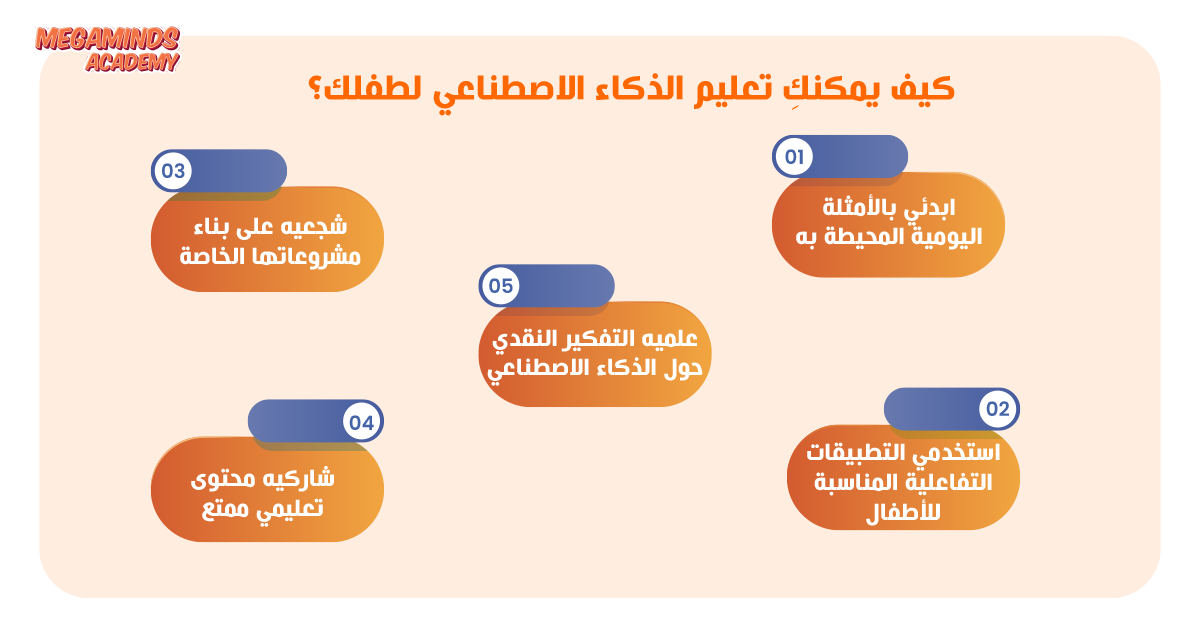
Everyday uses of AI apps for kids can be turned into a fun learning opportunity that helps your child understand how artificial intelligence works and develop their logical and creative thinking skills.
Start with the everyday examples around them
You can introduce artificial intelligence to your child through familiar situations. Explain to them how the voice assistant recognizes their voice when they say "Hey, Siri," or how photo apps can adjust lighting and recognize faces.
If they love video games, tell them about how the characters within the game learn from their actions and improve their performance over time.
Use interactive apps suitable for kids
There are many apps that make understanding artificial intelligence easy in a fun, interactive way. Scratch, for example, helps them create animations and simple games using visual programming, which develops their logical thinking skills.
Teachable Machine by Google, meanwhile, lets them train an AI model themselves by inputting images or sounds, so they can see how artificial intelligence learns and makes decisions.
Encourage them to build their own projects
The best way to understand artificial intelligence is through hands-on experience. You can encourage them to design a small interactive game, or use tools like LEGO Mindstorms to create a simple robot and control it through programming.
They can also try training an AI model to recognize animal images or analyze different sounds, which gives them a fun, practical experience that deepens their understanding of this technology.
Share fun educational content with them
If your child loves watching videos, take advantage of that by showing them age-appropriate educational content. There are many cartoons and interactive videos that explain AI concepts in a simple, child-friendly way.
Teach them critical thinking about artificial intelligence
It's important that your child isn't just a user of technology, but understands how these systems work and the limits of their capabilities.
Encourage them to ask questions: How does artificial intelligence decide which video YouTube suggests? Can it make mistakes? How can we improve it? These discussions will make them think more consciously when using technology, which strengthens their critical and creative abilities.
How can you make your child's experience with AI technologies more beneficial?
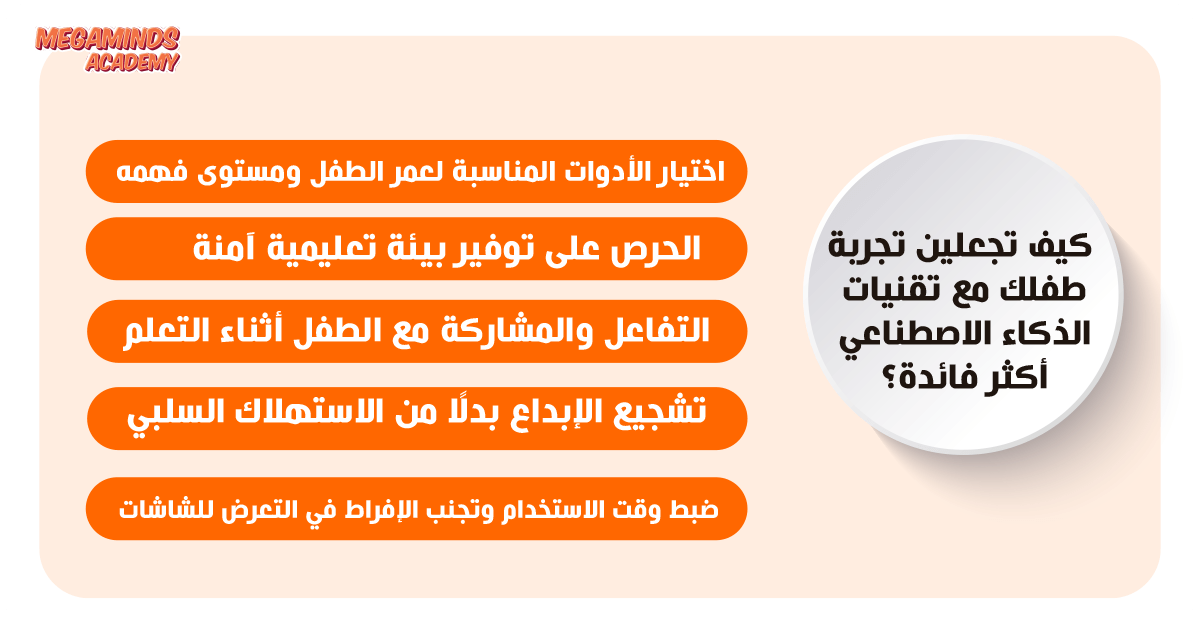
Using AI technologies and tools in children's education can be a rich and enjoyable experience, but to ensure you get the most out of them while keeping your child safe, there are a few guidelines worth keeping in mind, such as:
Choosing tools suited to the child's age and level of understanding
Not every AI app or tool is suitable for all age groups, so it's important to choose programs that match the child's abilities and learning level.
Some apps are designed for beginners and use simple visual methods, while more advanced tools suit older children or those with prior programming knowledge.
At "Megaminds Academy," we are committed to offering comprehensive learning paths suited to different age groups, helping mothers choose the tools and apps that match their children's level and keep pace with their cognitive development.
Ensuring a safe learning environment
Some AI apps may require access to the microphone, camera, or personal data, so parents should review the privacy settings and make sure the child's sensitive information is not at risk.
It's best to choose apps that comply with safety and child-privacy standards such as COPPA or GDPR-K.
Interacting and participating with the child during learning
Technology is not a substitute for human interaction, so it's best for parents to take part in the learning experience, whether by asking questions, discussing what the child is learning, or even trying out the tools together. This not only enhances understanding but also makes learning more fun and motivating for the child.
Encouraging creativity instead of passive consumption
Instead of letting the child rely only on using apps, you can guide them toward creating their own projects using AI tools, such as designing an interactive story in Scratch or training a simple AI model using Teachable Machine. These experiences develop critical and creative thinking skills, rather than simply consuming technology without understanding it.
Managing usage time and avoiding excessive screen exposure
Although AI apps offer valuable educational content, excessive screen use may affect a child's social and physical development.
It's best to set specific times each day for using these technologies, while encouraging real-world activities such as traditional play or reading to develop the child's motor and social skills.
Frequently asked questions
As the use of artificial intelligence grows in our daily lives, you may have some questions about how it affects your child, how safe it is to use, and the best ways to benefit from it in learning and development.
How can artificial intelligence be used in kindergarten?
Artificial intelligence can be used in kindergarten to improve the learning experience and make it more interactive and fun. Smart apps can provide educational activities tailored to each child based on their level, such as language- and math-learning apps that adapt to their pace of comprehension.
Voice assistants like Alexa and Google Assistant also help answer children's questions in a simplified way.
In addition, augmented reality tools can make interactive stories and science experiments more exciting, enhancing learning through play. Finally, data analysis technologies help teachers better understand each child's needs and provide appropriate individual support.
How can children use artificial intelligence?
As we mentioned, children can use artificial intelligence in many ways suited to their ages and interests. They can interact with voice assistants like Siri and Google Assistant to ask questions and learn in fun ways.
They can also use AI-based educational apps, such as language-learning programs or interactive math problem-solving.
In addition, there are smart games that rely on artificial intelligence to provide challenges matched to each child's level and help them with critical thinking. They can also try programming using tools like Scratch and Teachable Machine to understand how artificial intelligence "learns" from data.
How does artificial intelligence affect children?
Artificial intelligence is a powerful educational tool, helping children develop critical thinking, creativity, and problem-solving skills through interactive experience. It also nurtures their scientific curiosity and understanding of technology through applications such as robots, voice assistants, and smart games.
But, like any other technology, it has some negative effects, such as overdependence on devices, reduced social interaction, or exposure to inappropriate content.
That's why it's important to maintain a balance in its use through:
- Setting screen time and not overusing AI-based apps.
- Encouraging real-world interaction by combining technological learning with hands-on activities.
- Monitoring content and making sure the child uses tools that are safe and age-appropriate.
This way, we can make the most of artificial intelligence while minimizing its risks, helping children grow in a healthy, safe way.
Finally, artificial intelligence is no longer a technology far removed from the world of children; it has become part of their daily lives and a powerful tool for developing their skills and boosting their creativity.
By choosing the right apps and tools, you can provide a fun, safe learning experience for your child, one that opens new horizons for them and prepares them for a future that relies increasingly on technology.
Most importantly, accompany your child on this journey to ensure they get the most out of artificial intelligence in a positive, effective way.