
The Complete Guide to ADHD in Children

At first, nothing seemed unusual, just a child bursting with energy, running everywhere, looking as though he were powered by a battery that never runs out.
But little by little, you started noticing other things: he forgets where he put his toys, loses interest in any activity within minutes, never finishes his homework, and with every attempt to rein him in, you find him as if he's living in another world.
"It's just high spirits!" everyone reassures you, but deep down a question keeps nagging at you: could this be ADHD? Is my child different? And is there a way to help him focus more without losing my patience every single time?
In this article, we'll help you understand ADHD clearly: how to tell it apart from normal high energy, and what steps you can take to support your child and turn that boundless energy into a strength that sets him up for success.
What Is ADHD (Attention-Deficit/Hyperactivity Disorder)?
Your child seems full of energy, always on the move, asking dozens of questions a minute, jumping from one topic to the next as if he's chasing one idea after another.
You try to get his attention, but moments later he's forgotten what you were saying. He starts his homework, then suddenly abandons it to go look for something more exciting.
Is it just excess energy? Or is there something more going on?
Attention-Deficit/Hyperactivity Disorder (ADHD) isn't merely mischief or a lack of focus; it's a neurological condition that affects a child's ability to control his attention, his movement, and his reactions.
A child with ADHD isn't lacking in intelligence or understanding, but he engages with the world differently: thoughts crowd his mind, movement feels almost involuntary, and focus comes and goes without warning.
The Causes of ADHD in Children
According to a study by the National Institute of Developmental Psychiatry for Children and Adolescents in Brazil, ADHD is one of the most common neurological disorders among children and adolescents, affecting roughly 5% of children under the age of 18. Among its most prominent causes are:
1. Genetic Factors
Genetic factors are among the most significant contributors to ADHD, and research confirms that genes play a major role in its onset. One traditional way of studying this influence relies on twin studies, which allow researchers to measure the heritability of the disorder with precision.
One analysis of twin studies indicates that the heritability of ADHD ranges between 77% and 88%, making it one of the psychiatric disorders most strongly linked to genetic factors.
This data shows that ADHD is not simply the result of environmental or upbringing factors; it has a strong genetic basis that makes it similar in nature to other complex psychiatric disorders.
2. Environmental Factors
In addition to genetic predisposition, there are environmental factors that increase a child's risk of developing ADHD. These factors can begin as early as pregnancy and extend into early childhood. They include:
Problems during pregnancy and birth
- A mother smoking during pregnancy raises the child's risk of ADHD.
- Exposure to toxic substances such as lead can affect brain development.
- Premature birth and oxygen deprivation at birth can affect neurological function.
Environmental influences in childhood
- Children who have experienced severe psychological stress or neglect in early childhood may be more susceptible.
- An unstable home environment or the absence of routine can worsen symptoms in a child who is genetically predisposed.
3. Nutrition-Related Factors
Some research suggests that dietary patterns may play a role in increasing or reducing the risk of ADHD, prompting scientists to propose nutritional interventions as complementary treatments. These interventions include dietary supplements, improving gut health through probiotics, and following specific diets.
How Does ADHD Affect a Child's Behavior at Home and at School?
A child with ADHD means a schedule crowded with chaos, scattered words, and constant attempts to capture his attention.
At home:
- You repeat instructions over and over, but he seems not to have heard them.
- He starts playing with one toy, then suddenly drops it for another with no clear reason.
- He talks a lot, cuts you off mid-sentence, and asks about something completely unrelated to what you were saying.
- He forgets to tidy his room, yet remembers tiny details about a movie he watched a month ago.
And at school:
- He can't sit still for long; he gets bored quickly and starts moving around.
- He struggles to finish his assignments, not because he doesn't know the answers, but because his focus drifts.
- He answers questions before the teacher has finished asking them.
- He may seem inattentive during the lesson, yet he picks up information in unexpected ways.
It's worth noting here that a child with ADHD doesn't do this on purpose; he simply needs different ways of engaging with his world. So instead of expecting him to behave like everyone else, you need to understand how his brain works and how you can channel that abundant energy into more productive paths.
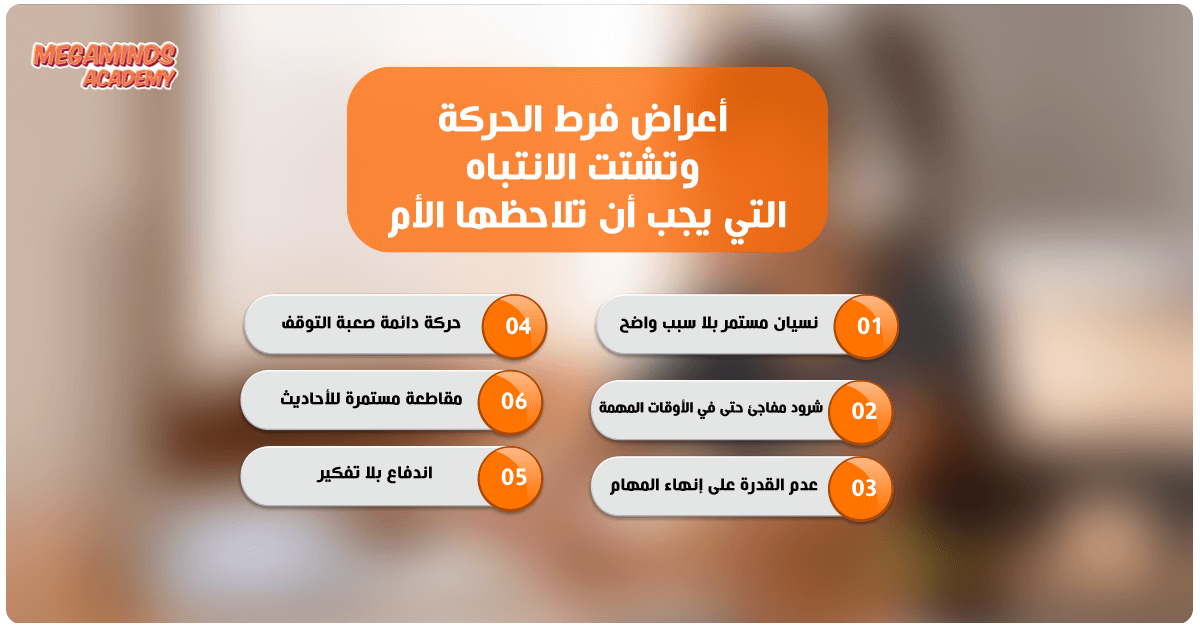
The Symptoms of ADHD Every Mother Should Watch For
There's that child who leaps from one idea to the next as if his mind were a train station crowded with overlapping journeys.
You try to hold the thread of a conversation with him, but it slips away between one question and another, between a sudden movement and a fleeting fascination with something shiny on the table.
Every time you ask him to do something, he starts, then forgets, then remembers something else, then stops without realizing why.
It may all sound familiar, since every child has moments of distraction and restlessness. But when this pattern becomes the rule rather than the exception, and when daily life turns into a series of baffling chaos, that's when you should pay attention.
Among the most noticeable signs are:
Constant forgetfulness with no clear reason
You tell him to put his shoes away, and he nods in agreement, but the next moment he's standing in the middle of the room, bewildered, asking, "What were you saying?" Then he goes looking for the shoes as if they hadn't been in his hands moments earlier. He forgets where he put his favorite toy, even though he was playing with it a minute ago. He forgets why he walked into a room, why he went to the kitchen, and even when you ask him to do something, he starts but forgets before he finishes. You might think this is normal, since all children forget, but when forgetfulness becomes the rule rather than the exception, that's where the problem lies.
Sudden distraction, even at important moments
You're telling him something important, but you find his gaze wandering to the ceiling, or to a toy beside him, or perhaps to nothing at all. You ask him to repeat what you said, and he looks at you with empty eyes and gives an answer that has nothing to do with the question. At school, the teacher is explaining an important lesson and everyone is taking notes, but he's staring out the window, wondering, "Why don't birds fall out of the sky?" In his world, everyday details are easily erased, replaced by random thoughts that carry him far away.
An inability to finish tasks
When you ask him to tidy his room, he starts enthusiastically, puts a few toys away, then finds a colorful book and starts flipping through it, remembers he wants to draw something, so he goes to grab his pencils, then a glass of water gets in his way, so he drinks from it and leaves it on the table, and he ends up leaving the room entirely, with the mess just as it was.
He may seem scattered, but he isn't lazy or stubborn; his mind simply pulls him in many directions, as if each new idea draws him in like a magnet, leaving everything before it unfinished.
Acting on impulse without thinking
He sees a bicycle in the street and suddenly runs toward it without looking left or right. He speaks up in the middle of a gathering of adults without realizing he has interrupted an important conversation.
He touches the hot cup of tea without thinking about the consequences, then looks at you, surprised by the pain, as if what happened were completely unexpected. Every movement, every word, every action comes first, and only afterward, if at all, does he think about the consequences. It's not that he doesn't care; it's that his mind doesn't give him the chance to pause before he acts.
Constant movement that's hard to stop
When he sits down, he doesn't really sit; he squirms, jiggles his leg, and shifts position every few minutes, as if he were trapped inside his own little body that refuses to be still.
At school, the teacher asks everyone to sit quietly, but moments later you find he has slid off his chair, or stood up for no reason, or is twirling his pen nervously between his fingers. Even while watching TV, the one time children usually sit motionless, you see him bouncing between the couch and the floor, as if staying still were simply out of the question.
Constantly interrupting conversations
You're on the phone, but he interrupts you with a sudden question about something else entirely. You try to finish a sentence with a family member, but he jumps in to tell you about a dream he had last night. In class, he raises his hand to answer before the teacher has finished asking the question.
It's not disrespect, and it's not stubbornness; he simply can't wait, as if every thought passing through his mind has to come out immediately, before it gets lost in the crowd. His mind works fast, and his tongue tries to keep up with that speed, but it often races ahead.
The Difference Between Mischief and ADHD
In every home there's that child who never settles down, jumping from one place to another, running through the house, and maybe climbing the furniture like a little tiger that knows no rest. Here you ask yourself: is he just a mischievous child who loves to play and move around, or is there something deeper at work, like ADHD?
The truth is that the difference between normal mischief and ADHD isn't just about the level of activity, but about a child's ability to control himself when asked to. A mischievous child may be active all day long, but when asked to sit quietly for a set period, he can do it, even if with difficulty. For a child with ADHD, however, it's beyond his control, as if his mind refuses the very idea of stopping, even when he wants to himself.
Questions to Help a Mother Assess Her Child's Behavior
If you feel unsure, try this simple quiz. Answer "yes" or "no" to the following questions, then compare your results:
- Does your child find it hard to stay seated even for a short while, even while watching TV or eating?
- When you ask him to finish a simple task, like tidying his toys, does he start but fail to finish because he gets distracted by something else?
- Does he frequently forget where he put his things, or what he was supposed to do just moments ago?
- Does he constantly interrupt conversations and talk out of turn, even in situations that call for quiet?
- When you give him directions, does he seem to be listening but not really take in what you said, or forget it quickly?
- Does he sometimes act impulsively, like running into the street without thinking, or touching hot objects without any awareness of the danger?
- Does he struggle to manage his time, or to carry out tasks that involve more than one step?
- Do his teachers or relatives say that he can't focus on anything for long?
- Does he seem constantly distracted, even during activities he enjoys?
- Do you feel that he doesn't learn from his mistakes, repeating the same behaviors without remembering their consequences?
If you answered "no" to most of these questions, your child is most likely just an active, mischievous kid who can control his behavior when he needs to.
But if most of your answers were "yes," it's important to consult a specialist to better understand your child's behavior.
Ways to Support a Child with ADHD
Raising a child with ADHD isn't a battle, but it's certainly a journey that calls for patience and a clear sense of direction.
Between home, school, and the wider community, your child needs ongoing support to adapt and engage with the world around him. Here are some strategies to help you manage his day more calmly and effectively.
How to Support a Child with ADHD at Home
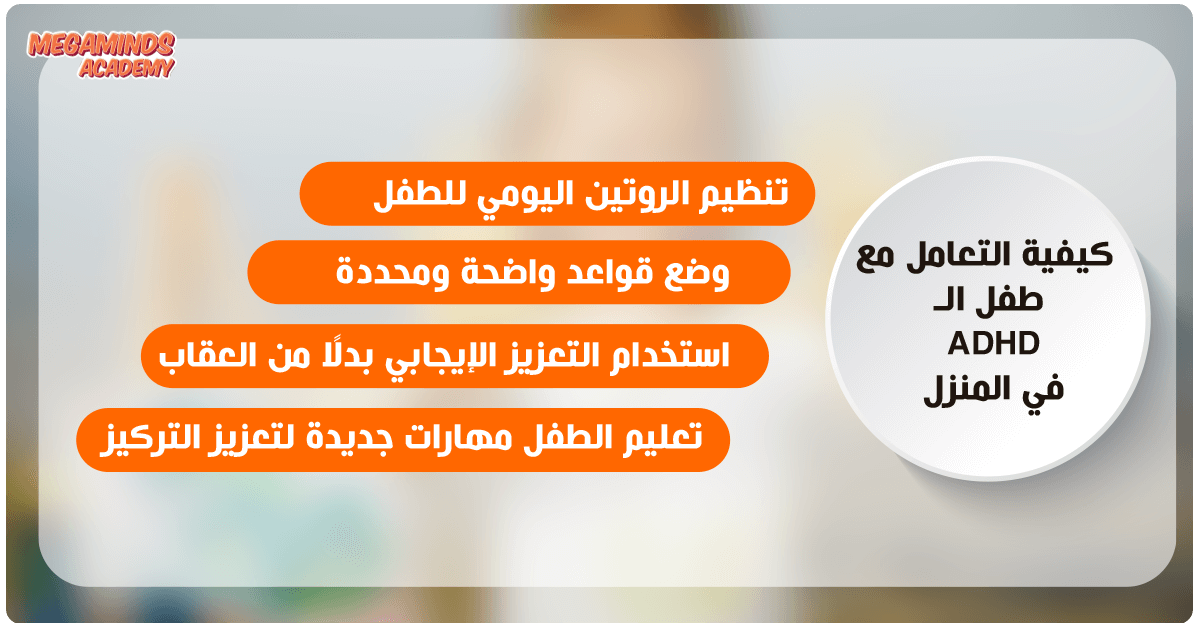
Home is a child's first refuge, the place where he learns how to handle himself and relate to others. That's why establishing a clear system helps reduce the mental chaos he experiences. To that end, you should:
Organize the child's daily routine
Routine is the key to stability for a mind that's always wandering. When a child knows there's a set time to wake up, to play, to finish homework, and to sleep, his day becomes clearer and less stressful.
Set clear, specific rules
Your child doesn't have a problem following rules; his problem is grasping vague ones. Instead of saying "Be polite," use phrases like "When someone is talking, wait until they finish before you respond." Clear, direct rules give him a sense of control over his behavior.
Use positive reinforcement instead of punishment
Motivation works better with your child than punishment. When he does something positive, show him your appreciation right away, whether with a word of encouragement, a star on a reward chart, or a small treat. Appreciation makes him want to repeat the behavior, unlike punishment, which may make him more rebellious or discouraged.
Teach the child new skills to strengthen focus
Teaching a child new skills like coding is an effective way to boost his focus and strengthen his ability to solve problems in a methodical way.
Activities that require logical thinking and experimentation, such as coding, help a child develop attention and stay on a given task for longer.
At Megaminds Academy, we help you turn your child's coding journey into an enjoyable experience through tailored programs and learning paths.
How to Support a Child with ADHD at School
School can be a battleground for a child who struggles to focus or sit still, but it's also a wonderful opportunity to develop his skills if he gets the right support.
That's why it's important to explain your child's condition to his teachers, and how they can help him, such as giving him extra time to finish tasks, allowing him to move around between lessons, or using visual aids in their teaching.
A few simple adjustments can make a big difference, such as:
- Seating him away from sources of distraction
- Breaking long tasks into small parts
- Using visual learning tools such as mind maps
How to Support a Child with ADHD in Social Life
Friends are a child's window onto the world, but ADHD can make building social relationships a challenge for him.
So help your child understand the unwritten rules of friendship, such as listening to others, not interrupting, and apologizing when he's wrong. Encourage him to play in small groups, and introduce him to children who share similar interests.
You may hear comments like "Your child needs stricter discipline" or "Why can't you control him?" Instead of getting angry, take a deep breath and be ready to explain the nature of ADHD to those around you, or simply ignore unhelpful criticism.
In the end, ADHD isn't a life sentence for your child; it's a challenge that needs proper management.
Your child isn't "naughty" or "stubborn"; he simply sees the world differently. With support and understanding, he can succeed, shine, and prove that the energy he carries within is nothing but fuel for achievement, when it's directed down the right path.