
Why Children Lose Self-Confidence and How to Rebuild It

I was watching a little boy try to tie his shoe. He struggled with his tiny fingers, his forehead beaded with sweat, but he failed and let out a frustrated sigh. His mother rushed over to help, tied the shoe in a second, then smiled, but he did not smile back.
Why do some children lose confidence in themselves so easily? Are they born that way, or do certain words and moments quietly pile up until they convince a child that they simply aren't capable?
In this article, we uncover the causes of low self-confidence in children and how we can rebuild it before it becomes part of who they are.
What Self-Confidence Means for Children
A confident child is the one who stands in the middle of the room holding a strangely shaped drawing and tells you, with total assurance: "Look! I drew a super monster that can fly through space!" You stare at the paper and see nothing but unreadable scribbles, but the child sees a work of art. This is self-confidence in its purest form.
Self-confidence is not a trait that is handed out, nor a medal to be pinned on. It is an inner feeling that is born through experience, grows with encouragement, and withers under constant criticism.
From the moment a child becomes aware of the world, they begin to test themselves: Am I capable? Can I do it? And every time they face a challenge, they lay a small brick in the wall of their self-confidence. That wall can become as strong as a fortress, or as fragile as a house of paper, depending on the reactions they meet.
Children are not born brave, nor are they born fearful. They are born as a blank page, and then society, parents, friends, and even the glances of strangers begin to write lines on that page.
If it is filled with motivation and encouragement, the child grows up seeing themselves as able to conquer the world. But if it is filled with scolding and crushing comparisons, they grow up believing the world is far bigger than they are, and that they are nothing but a tiny ant in a crowd of giants.
The Causes of Low Self-Confidence in Children
A child is like a young branch: it grows straight when someone cares for it, but it can bend under the force of the wind if left alone in the path of storms. Self-confidence is the product of the experiences children go through, and among the most prominent causes of low confidence we find:
1- Negative Experiences and Repeated Failures
A child steps forward to enter a drawing contest, draws with great enthusiasm, but loses. They try jumping rope and fall. They try stacking their blocks, and the tower collapses in their hands. What happens next?
If they are surrounded by someone who says, "It's okay, trying makes you stronger!" they will try again and build the wall of their confidence brick by brick. But if their attempts are met with mocking laughter or cold indifference, they will start avoiding the experience altogether.
Repeated failure without support is like a strong wind battering that young branch, breaking it bit by bit. And when they grow up, they become a young person who fears adventure, dreads failure, and hesitates before taking any new step, as if they were created to stay behind the scenes while others take the stage.
2- Constant Criticism and Negative Comparisons
"Why can't you be more like your cousin?"
"Your handwriting is terrible, you'll never be any good at writing."
"How many times have I told you not to do that? You never learn."
Just like that, with a few passing words, a child's self-confidence shatters the way a fragile mirror shatters on the floor. A child is like a sponge, absorbing everything said to them, and every comparison drawn between them and others digs a small hole inside them that widens as the days go by, until they become convinced that they will never be good enough.
Constant criticism is like drops of water falling on a rock; it may seem harmless at first, but over time it carves a gap that cannot be filled.
This is not mere speculation or exaggeration. A study published in the journal Social Cognitive and Affective Neuroscience indicated that ongoing parental criticism does not only affect self-esteem, but can have deeper psychological consequences, as it is linked to the emergence of mental health disorders and self-harming behaviors later in life.
A child who is exposed to harsh, repeated criticism grows up feeling inadequate, incapable of success, and undeserving of support or love.
3- Lack of Support and Encouragement from the Surrounding Environment
There is a type of child who walks through life as if carrying a heavy bag on their back, a bag full of letdowns, because they never found a hand reaching out to push them forward.
Encouragement is the fertilizer that makes a child's self-confidence blossom. A simple phrase like "I'm proud of you" can make the difference between a child who feels able to face the world and another who feels like nothing more than an extra number in life. A child who grows up in an environment empty of appreciation will not try, will not experiment, and will never believe that they deserve success.
4- Bullying and Persecution by Peers
When a child is a victim of bullying, they do not just receive harsh words; they receive indirect messages that their worth is small, that they are weak, and that they do not deserve respect. With every time they are mocked, and every time they are pushed for no reason, their self-confidence melts like a piece of ice left under the midday sun.
This is where parents come in: they can either be a shield that protects the child, or they can leave them alone to face a merciless storm.
For a child to hear their parents say "just ignore them" while feeling their dignity crushed every day is like being asked to swim in a raging sea without knowing how to move their feet in the water.
5- Academic Pressure
"You have to get the top grade."
"Why weren't you first in your class?"
Parents who think they are motivating their children this way do not realize they are placing them under pressure beyond what they can bear. It is fine to encourage your child to excel, but making them feel that their worth in life depends on an exam paper is enough to make them live in constant fear of failure and place their self-confidence in the hands of numbers and grades.
A child forced to meet expectations beyond their capacity is like a circus performer walking a tightrope above blazing flames. They may succeed for a while, but the moment they lose their balance, they will find no one reaching out to save them.
6- Family Problems and Household Instability
Home is the first world a child knows. If that world is full of shouting, conflict, and instability, how can the child grow up confident?
A child who watches their parents fight every day, feeling that the home could fall apart at any moment, will have no chance to think about developing themselves. All their focus will be on emotional survival, on how to avoid trouble, on how to be invisible so they don't become part of the conflict.
Family stability is the ground on which self-confidence grows. If the ground is solid, the child grows up strong. But if it is fragile and full of cracks, all they can do is shrink into themselves for fear of falling.
7- Health or Physical Problems
When a child stands in front of the mirror and sees how they differ from others, whether because of a physical disability, a health condition, or even a different appearance, doubt begins to creep in. Am I normal? Will I be accepted? Will others look at me strangely?
In a society that shows no mercy to difference, a child with a health condition feels like a strange creature among a group of ordinary people. And here, parents play a role in helping them see their difference as a strength rather than a weakness, in helping them realize that their worth is not defined by how they look, but by what they are able to do.
Sometimes, a child simply needs someone to tell them: "You are wonderful just as you are." This simple sentence may be the only barrier standing between them and an inner collapse.
Strategies to Strengthen Self-Confidence in Children
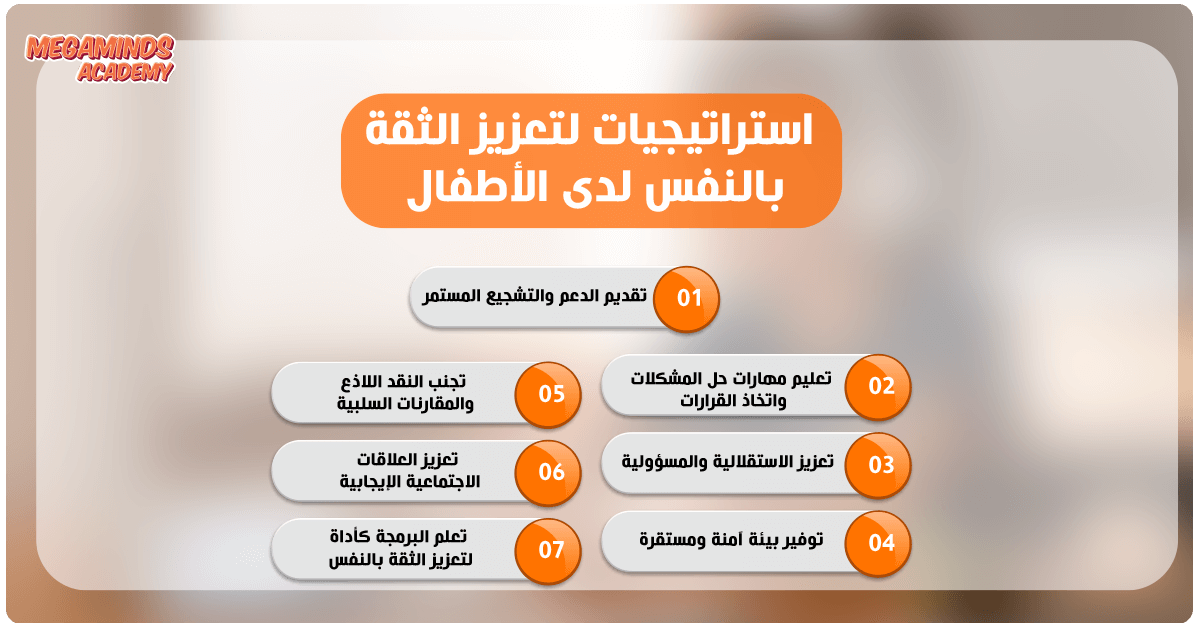
Self-confidence is not a button we can switch on inside our children's minds; it is a seed we plant and water day after day, until it grows into a shady, flourishing tree. Among the most prominent ways to strengthen it:
1- Offering Constant Support and Encouragement
A child is like a little painter, drawing their first picture with random colors and uneven lines. But if they hear you say, "What a wonderful drawing!" they will draw again, and a third time, until they truly become an artist. But if they hear, "What is this? You tried but you failed!" they will throw their brush aside and perhaps never try again.
Encouragement is a lifeline. Acknowledging a child's achievements, even the small ones, is what makes them believe they are capable. Phrases like:
"I'm proud of you for trying!"
"It was hard, but you didn't give up, and that's wonderful!"
"I love the way you thought about solving the problem!"
These words leave a deep mark, because they tell the child that their worth lies not in the result, but in the effort and the trying.
2- Teaching Problem-Solving and Decision-Making Skills
The world is not a simple place; it is full of challenges and situations that require thinking. If a child grows up relying on others to make their decisions, they will not be able to trust themselves when they need to make a real decision later on.
So instead of choosing their clothes for them every day, ask them: "How about you choose what to wear today?"
When they face a problem with one of their friends, instead of stepping in right away, ask them: "How do you think we can solve this situation together?"
Every time a child is given the chance to think and make a decision on their own, they lay another brick in building their self-confidence.
3- Encouraging Independence and Responsibility
There is a difference between a child who waits for their mother to tie their shoe and a child who tries to do it themselves, even if it takes an extra five minutes. A child who is given the chance to be responsible for some things in their life feels capable and feels that they do not always need others.
Let them take part in some simple household chores, like making their bed or putting their clothes in the closet. The more a child feels responsible for something, the more their self-confidence grows, because they see that they are able to manage their own life, even in a small way.
4- Providing a Safe and Stable Environment
How can a child be confident if they feel they are living in the middle of a constant earthquake? Family conflicts, shouting, and emotional instability all make a child feel in danger, and when they feel in danger, they will have no space to think about themselves or develop.
So make the home a safe place for conversation, not a battlefield. A child who grows up surrounded by shouting will learn fear, not confidence. And make sure they feel loved unconditionally, not because they excel or because they are "good," but simply because they are who they are.
5- Avoiding Harsh Criticism and Negative Comparisons
"Why can't you be like your brother?"
"Look at the neighbors' son, he's excelling, and you do nothing!"
With sentences like these, we tear down part of a child's self-confidence every time they hear them. A child who is compared to others feels lesser than them, even if they are gifted in something else.
Instead of comparing, we should focus on developing their individual skills. For example:
- If they love drawing, support them even if they are not the best at school.
- If they are passionate about numbers, encourage them to solve math puzzles instead of focusing on their weakness in writing.
- If they struggle with something, help them improve without belittling their abilities.
6- Strengthening Positive Social Relationships
A child who has good friends feels loved and accepted, and this is reflected in their self-confidence. Encourage them to make friends, and teach them how to deal with others in a healthy way. So it is essential to:
- Let the child take part in group activities, such as sports or school trips.
- Teach them how to express themselves confidently without fear of rejection.
- Help them see that minor disagreements with friends are normal and are not a sign that they are unlikeable.
7- Learning to Code as a Tool to Strengthen Self-Confidence
Can learning to code be a way to strengthen a child's self-confidence?
Absolutely! Coding is not just a technical skill; it is a way of thinking, and a tool that gives a child a sense of power and the ability to accomplish.
When a child writes a simple line of code and sees the result in front of them, they feel they have accomplished something tangible.
Coding teaches a child problem-solving and logical thinking, and it is a skill that strengthens their confidence in their ability to face challenges.
For example, when a child creates a simple game or a small app, they feel they are not just a user of technology, but a maker of it, and this completely changes the way they see themselves.
This is where "Megaminds Academy" comes in, an academy that does not just teach children to code, but turns the experience into an enjoyable journey full of challenges and adventures.
We rely on an interactive teaching approach, where the child learns through hands-on projects, which strengthens their sense of achievement with every step they take.
At "Megaminds Academy," the child gets a supportive environment that encourages them to be creative and to experiment without fear of making mistakes, which makes them bolder in facing challenges, whether in coding or in life in general.
In addition, children learn teamwork and cooperation with their peers to solve problems, which strengthens their social skills alongside their self-confidence.
Conclusion
Self-confidence is not just words said to a child; it is an experience they live every day. It grows when they are allowed to try, when they are encouraged instead of criticized, and when they feel loved regardless of their success or failure.
A child who receives support and encouragement, and who learns how to face challenges instead of avoiding them, becomes more able to face life with confidence. And when they are given the chance to gain new skills, like coding at "Megaminds Academy," they do not just acquire technical knowledge; they learn how to think, how to solve problems, and how to trust their own abilities.
If we want strong, independent, self-confident children, we must be the first to believe in them, because a child who sees confidence in their parents' eyes will find it within themselves too, and will head into the future knowing full well that they are capable of achieving their dreams, step by step.